
.avif)
Usage-based pricing has exploded in the last decade, and now AI-driven features are pushing monetization models even further – introducing complexity that legacy ERP setups weren’t designed to handle.
This raises a key question: can your financial infrastructure keep pace with these new revenue streams?
According to Stripe, 38% of businesses have lost deals because of inflexible billing systems, 52% are frustrated with their subscription process speed – and 55% will likely get a completely new billing system.
This article explores why keeping billed AI inside your ERP creates a critical advantage for finance teams, how to address common challenges with usage-based billing for AI services and what to look for in a solution that extends your ERP's capabilities without creating disconnected systems.
Key highlights:
- Usage-based billing for AI services refers to pricing models that charge customers based on actual consumption – tokens, queries or credits – rather than fixed fees.
- Traditional ERPs struggle with AI billing complexity, from fluctuating usage and expiring credits to shifting pricing tiers.
- Managing AI feature monetization in disconnected tools or spreadsheets slows finance and increases reconciliation risk.
- ZoneBilling for NetSuite embeds billing automation directly in your ERP, enabling AI-specific, hybrid and usage-based pricing without adding extra systems.
Why billing for AI usage isn’t as simple as adding a new product
Billing for AI usage introduces a layer of complexity beyond traditional B2B transactions. While many businesses consider their offerings a “subscription”, the addition of AI features creates unique challenges driven by factors such as:
- Fixed platform fees for core product access
- AI-specific charges (token, queries, completions)
- Usage thresholds with different pricing tiers
- Credits that expire or roll over
- Service components with separate billing cadences
An AI chatbot feature won’t be just another product you add to your billing process. This dynamic service, with usage that fluctuates daily, will most likely require a different AI billing logic than your core offering.
This is a classic example of attribute-based billing – pricing that depends on variable usage metrics like the number of tokens processed, API calls made or AI outputs generated. Unlike flat-fee subscriptions, this kind of model requires tracking usage at a granular level, applying pricing logic in real-time and aligning revenue schedules to actual consumption.
Process breakdowns
If your billing tech stack isn’t integrated and you don’t leverage automation to handle the billing complexity that accompanies AI pricing, your financial scalability will be limited by manual processes and Excel workarounds. Your finance teams will quickly hit operational bottlenecks:
- Manual tracking of AI consumption metrics
- Complex calculations for tiered pricing in spreadsheets
- Reconciliation challenges between usage data and invoices
- Revenue recognition timing mismatches
- Compliance risks with prepaid AI credits
Reputational risk
These challenges aren’t just on the tech side either. Consider what happens when customers receive their first AI usage bill. Did they understand what they were paying for? Can they verify the usage metrics? Or do they question the invoice?
According to a recent article by Glen Coyne: “When a customer in the US or UK questions their bill, your ability to provide a clear, auditable log of their usage is paramount. If you cannot, you lose credibility.”
Billing errors surrounding new and unfamiliar services – especially when they’re related to usage – can quickly eat into your customers’ time and resources and damage your reputation.
Growth barriers
Financial scalability hinges directly on how your ERP handles billing and revenue recognition for evolving models, pricing changes and additions. Rapid growth will only magnify these challenges. If your ERP can’t handle AI pricing models today, it won’t scale tomorrow.
“Having the potential to handle hundreds of thousands of transactions a month in three to five years while operating in the same environment is really important. Companies are looking for that scalability because, if they try to swap systems during a major growth phase of their business, it can wreak a lot of havoc.” – Derek Hitchman, NetSuite practice leader at CrossCountry Consulting
The best time to build a scalable AI billing infrastructure is before you outgrow your current setup. If finance teams are already hitting reconciliation bottlenecks, that’s a sign your ERP isn’t equipped for AI monetization.
3 most common misconceptions and risks of managing AI billing outside your ERP
Because AI monetization is relatively new and may not be well understood, we often hear some common assumptions about what it takes to implement AI pricing strategies. We’re breaking the most prevalent “myths” below.
AI billing management misconception #1: "We'll need a separate billing tool for AI-based pricing."
Many companies initially turn to outside billing tools for AI monetization. At first, it seems simple – plug in a specialized tool, track AI usage and generate invoices. But what happens when that data has to flow into the ERP?
The architecture becomes fractured almost immediately. Customer contracts live in your CRM. Usage data resides in your product database. Invoices originate in the billing platform. Payments land in the payment processor. And revenue recognition? That's still manual work in the ERP.
"If you're billing AI usage outside your ERP, you're creating unnecessary friction. Your finance team now has to reconcile records from multiple systems – your CRM, your billing tool, your ERP. That means more manual work, more risks of error and incompliance. The reality is, most companies end up using Excel as the ‘glue’ between systems, which is exactly what a finance team should be looking to eliminate within an integrated system." – James Hewitt, Finance leader and NetSuite ERP expert
Finance teams suddenly find themselves managing:
- Disconnected revenue data: AI charges live in one system, financial records in another. Deferred revenue tracking? Audit readiness? Now, manual processes.
- Duplicate work: If usage is billed in a separate tool, finance has to re-enter transactions into NetSuite or extract and reconcile them in Excel. That’s lost time – every month.
- Scattered reporting: Finance can’t pull real-time insights when AI revenue is buried in external billing tools. Financial forecasts start running on guesswork.
The more AI-powered revenue grows, the bigger these challenges become.
With AI-powered services, usage-based pricing isn't just about billing. The customer experience matters too, and they want to see exactly what they're paying for. Without clarity on invoices and inside a customer portal, they won't understand the value.
"AI billing has to be tightly integrated with ERP as billing isn't longer only a finance function, but it's becoming a core part of customer operations too." – Derek Hitchman, NetSuite practice leader at CrossCountry Consulting
By investing in an integration that simplifies and automates your AI billing strategy within your ERP, finance benefits from the following advantages across the order-to-cash cycle:
- One source of truth: No manual work to sync AI usage data with financials.
- Faster, automated invoicing: AI usage gets billed alongside all other revenue streams.
- Better financial reporting: CFOs and controllers can track AI revenue directly in NetSuite.
- Scalability: Whether AI is a small add-on or a major revenue driver, billing stays simple.
If you’re currently evaluating whether your ERP can truly support your evolving billing needs, our guide on the 30 billing questions to ask provides a framework for assessing your current system's capabilities and identifying where native ERP extensions like ZoneBilling can fill critical gaps – before investing in disconnected solutions.
AI billing management misconception #2: "Our ERP can't handle AI usage-based models like tokens, credits or API calls."
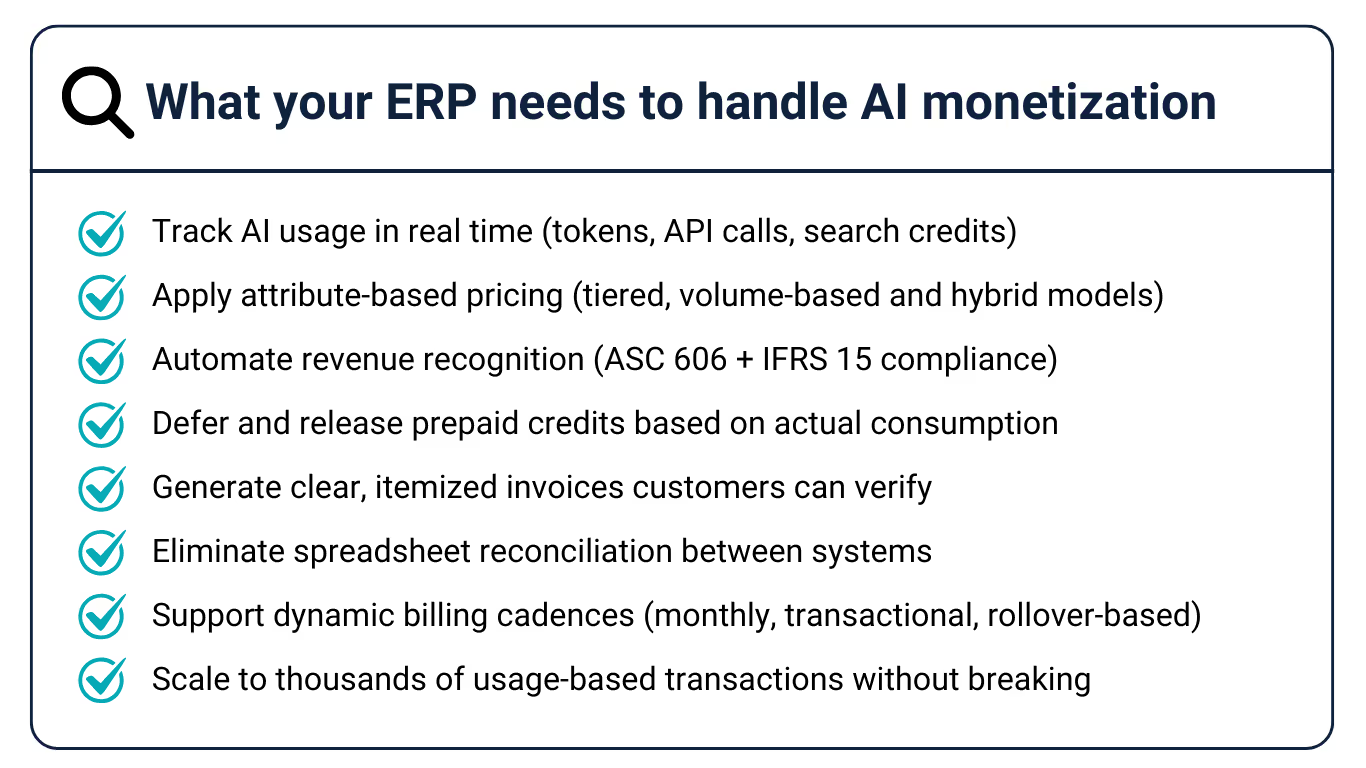
Many out-of-the-box ERPs will struggle with AI usage-based models like tokens, credits or API calls – but the solution isn’t moving billing outside the ERP. The right extensions (like our advanced billing management solution inside NetSuite) make it possible to:
- Automatically track AI usage metrics
- Configure flexible pricing tiers without custom development
- Bill accurately for actual consumption
- Recognize revenue properly inside your ERP
“You can structure your ERP to monetize the AI capabilities you're putting into your platform. With a powerful, embedded billing engine, you can cater for fixed fees, variable pricing and attribute-based pricing exactly as you structure the commercial terms to your customer." – James Hewitt, Finance leader and NetSuite ERP expert
That flexibility is exactly why AI service billing needs to be embedded inside the ERP – because you need full control over invoicing, usage tracking and revenue recognition in one place.
AI billing management misconception #3: "Revenue recognition for AI usage is too complex for our ERP."
AI pricing often requires deferred revenue tracking, since AI credits and tokens may be prepaid but used later. Because of this, many finance leaders assume their ERP can't handle the complexities of AI revenue recognition – but this misconception leads companies to create more problems than they solve.
Even if your ERP (e.g., NetSuite) cannot handle this complexity natively, proper billing integrations that live within the walls of the ERP actually excel at solving exactly these revenue recognition challenges:
- Automatically tracking consumption of prepaid AI credits across time periods
- Properly deferring revenue based on actual usage patterns rather than invoice timing
- Creating compliant revenue schedules that align with ASC 606 requirements
- Maintaining a clear audit trail between original purchases and revenue recognition events
Without these capabilities, finance teams resort to disconnected spreadsheets and manual processes – creating the very complexity they feared in the first place.
“An example of where ASC 606 may be triggered would be if a customer prepays for 200 AI credits and can be refunded for any unused – recognition here would be on consumption (i.e., 50 in the month), not upfront or straight line. That's why revenue recognition for AI features needs to be automated inside the ERP, where we can track usage and properly defer revenue based on actual consumption." – James Hewitt, Finance leader and NetSuite ERP expert
Are you prepared to explain to your executives, board or investors why your finance team manages critical revenue data in disconnected systems held together by spreadsheets?
Before investors start asking questions, take a step back and ask these internally:
- What's going to happen with the revenue when we add AI features to our product? CFOs need to track profitability by product. But if AI-generated revenue enters the books as journal entries without product tags, your reporting will be incomplete.
- How will we report on it? If pulling up future billing obligations means running reports across multiple systems, extracting data and manually piecing it together in Excel, scaling will be impossible.
- How will we reconcile deferred revenue? With invoices in one system and revenue schedules in another, your finance team ends up stitching it together in Excel.
Embedding billing for AI directly within your ERP creates a single financial source of truth. Usage data feeds straight into your core system, eliminating reconciliation headaches and providing real-time visibility into how each AI feature performs financially, both now and in the future as these add-on services expand and drive growth.
AI pricing models explained: Usage-based, tiered and hybrid billing strategies
AI pricing fundamentally differs from traditional subscription models. It's dynamic and usage-based, making it impossible to bill as a simple flat fee. Your billing system needs to accommodate:
- Fluctuating usage patterns that vary month to month
- Different consumption metrics (tokens, API calls, searches)
- Combinations of fixed fees and variable charges
- Volume discounts and tiered pricing structures
Here are the three core AI pricing models:
Usage-based AI pricing solutions
Usage-based billing for AI services ties cost directly to consumption. Customers pay for exactly what they use – no fixed fees, no wasted spend. OpenAI’s ChatGPT, for instance, charges per token processed. AWS AI services charge based on compute time, storage and API calls. Zoom AI analytics charges based on the number of videos processed with AI-powered insights.
Unlike tiered or prepaid models, usage-based AI pricing solutions are dynamic. Each billing cycle varies, requiring an ERP that can track usage at the transaction level. For example:
- AI tokens: Charged per unit of text processed, deducted from prepaid credits or billed at the end of usage
- API calls: Billed per request, often with pricing tiers (e.g., first 1M calls at $X, additional calls at $Y)
- Search credits: Prepaid or pay-as-you-go, requiring tracking for unused credits and adjusting revenue recognition
Inside an ERP, usage-based transactions flow directly into customer invoices and revenue schedules. Prepaid AI credits remain in deferred revenue until consumed. If customers don’t use them, finance must track expiration policies or roll unused credits forward. Without automation, this means manual schedule adjustments and compliance risks.
Hybrid models
Many businesses combine a base subscription fee with usage-based AI charges. This provides predictable recurring revenue while also capturing the value of increased AI usage.
For example, a company might offer its platform for a fixed monthly fee, but charge additionally for AI-powered features based on consumption. This model provides more stable revenue than pure usage-based pricing while still aligning costs with value.
Why is this model tricky to manage? Hybrid pricing creates two parallel revenue streams:
- Predictable revenue: A platform fee (fixed subscription)
- Variable revenue: AI-powered add-ons (billed based on consumption)
But what happens when these two revenue streams live in different systems?
When your fixed subscription is managed in your ERP but AI usage is tracked elsewhere, how does your finance team reconcile these for accurate reporting? What happens when a customer makes a single payment covering both components? How do you ensure proper revenue recognition when subscription and usage follow different schedules?
Keeping both revenue streams within your financial home – your ERP – eliminates these challenges. With the right billing integration inside NetSuite, both fixed subscriptions and variable AI usage can be managed in a single system.
This gives finance teams a complete view of customer relationships, streamlines invoicing, simplifies revenue recognition and ensures compliance without the manual reconciliation that often becomes a spreadsheet nightmare.
Tiered AI pricing
AI services often use tiered pricing, where costs decrease as usage increases. Customers are grouped into pricing tiers based on their consumption, encouraging higher usage while making costs more predictable.
For example, the first 1,000 AI processing minutes might cost $0.10 per minute, while minutes 1,001-10,000 cost $0.08 each, and so on. This means customers benefit from lower rates as they scale, but finance teams must track not just total usage but which portion falls within each pricing tier. Now, consider the challenges:
- What happens when a customer crosses a threshold mid-cycle?
- What if different AI features have separate tier structures?
- How does finance provide real-time visibility into how close a customer is to the next discount level?
Without automation inside your ERP, tracking tiered billing across hundreds of customers creates manual work, reconciliation issues and potential pricing disputes. Embedded NetSuite billing ensures tiers are calculated automatically, eliminating errors and freeing your finance team from constant monitoring.
How to implement usage-based billing for AI services
Here’s how to implement usage-based billing for AI services:
1. Define value metrics that reflect AI consumption
The starting point for usage-based billing is clarity – specifically, clarity around what “usage” means in your business. For AI services, that could mean tokens processed, model type, API calls, seat count or generated outputs. Each metric impacts how revenue is calculated, priced and recognized. Ambiguity here makes billing harder to scale and even harder to audit. Defined metrics, mapped directly to contracts, eliminate guesswork – and allow finance to build a direct, auditable path from usage to revenue.
How ZoneBilling can help:
- Apply usage-based pricing logic using tiers, floors or ceilings, prepaid or pooled consumption and overages
- Build contract-level billing setups with custom pricing, trial terms and customer-specific discounts
- Create a clear handoff from usage tracking to billing by mapping metrics to charge logic inside NetSuite
- Centralize billing and revenue operations in NetSuite to ensure compliance, reduce audit prep and eliminate sync issues
2. Structure usage data for billing
AI usage data rarely lives in one place. Logs may come from APIs, product telemetry or customer dashboards – often in formats that weren’t built for billing. If the data isn’t structured and aligned to contracts, finance ends up sorting it manually or correcting downstream errors. Forecasting suffers. So do audits. That’s why the best tools for usage-based billing in AI services structure usage data early – timestamped, tied to the customer and clean enough to flow directly into NetSuite for pricing and invoicing.
How ZoneBilling can help:
- Ingest usage data through saved searches, APIs or file uploads – no cleanup needed ahead of time
- Capture and pass key fields like usage date, quantity or model type directly into NetSuite
- Align incoming usage records with the right contract terms so billing reflects real activity
- Produce audit-ready charges from structured data and push them into invoices without switching systems
3. Let usage drive billing and revenue recognition
AI services don’t follow predictable billing cycles. Usage patterns shift. Contracts change. If finance relies on spreadsheets or external tools to keep up, billing falls out of sync and revenue recognition gets messy. The only scalable path is one where usage activity drives the billing process – triggering charges and posting revenue inside the ERP. That keeps pricing rules, billing schedules and revenue events aligned. No double entry. No guessing.
How ZoneBilling can help:
- Generate usage-based charges automatically using real-time contract terms and flexible pricing rules
- Post revenue using built-in schedules tied to charges, aligned with ASC 606 compliance
- Automate the entire quote-to-revenue flow within NetSuite – no external systems, no sync issues
- Maintain audit-ready traceability by linking each usage event directly to billing and revenue outcomes
4. Integrate finance, product and sales data
AI billing works best when systems are connected. When usage data, pricing logic and contract terms all feed into the same workflow – preferably within the ERP – finance can move faster with fewer errors. Pricing updates flow through automatically. Usage maps cleanly to contracts. Revenue gets posted on time. And teams spend less time reconciling changes and more time guiding the business forward.
How ZoneBilling can help:
- Sync contract terms from Salesforce into NetSuite so billing always reflects current pricing, discounts and renewal dates
- Link each usage event to the right customer and subscription, making every charge clear and accurate
- Keep billing, usage and revenue data in one place – no exports, no rekeying, no scattered records
- Adapt to changes mid-contract, like new products or pricing updates, without creating manual work or compliance risk
5. Monitor and iterate pricing strategies
AI pricing can change – either from a spike in demand, the introduction of a new language model or shifting cost structures. When pricing lives in the ERP, changes apply once and ripple everywhere – into billing, invoicing and revenue schedules. No rework. No side spreadsheets. Just clean updates that reflect how products are actually used and the ability to roll out and test new pricing quickly. That level of control turns pricing into a strategic lever rather than a quarterly fire drill.
How ZoneBilling can help:
- Build pricing curves that support volume tiers, marginal pricing and usage thresholds
- Apply discounts, trial pricing or contract-specific rates without touching global settings
- Introduce price changes mid-contract and keep billing and revenue schedules compliant under ASC 606
- Run pricing, rating and billing logic inside NetSuite so updates flow straight through quote to cash
Best tools for implementing usage-based billing in AI services
The best tools for implementing usage-based billing in AI services share some key traits – flexibility, automation and tight integration with the systems that hold customer, contract and revenue data. This comparison outlines the primary tool categories in the market and their best-fit use cases.
ZoneBilling brings the best of these tools together by embedding usage-based billing directly inside NetSuite. It combines automation, compliance and audit-ready reporting in one native solution, eliminating the need to sync data across disconnected platforms. With ZoneBilling, usage, pricing and revenue recognition all flow through a single, trusted system: your ERP.
Using AI service billing data to drive forecasting and growth
When AI billing is centralized, structured and connected, it becomes the foundation for smarter decisions. Finance teams can use it to track key metrics in real time, spot growth opportunities early and adjust faster. ZoneBilling captures usage, pricing and contract data for AI services at the source – and keeps it aligned inside NetSuite. That gives finance a direct line to the metrics that matter, from forecasted revenue to account health.
With everything in one system, teams can track key trends in real time, spot risk early and iterate pricing strategies quickly. There’s no need to wait for exports or end-of-month reports.
Transform usage data into predictive forecasts
With AI services, usage patterns spike and dip. Contracts shift mid-term. And one missed assumption can throw off a quarter. That makes manual forecasting – especially when built in spreadsheets – a last resort. It rarely keeps up with how fast things change.
ZoneBilling gives finance the structure and timing they need to forecast with confidence. Usage activity flows into NetSuite as it happens. Charge records update instantly. Teams can run usage scenarios, preview future charges and view forecasted revenue – all from within the subscription record.
With ZoneBilling, you can:
- Generate prospective charges based on usage and existing contract terms
- Preview projected charges and revenue in NetSuite subscription records
- Reduce manual work and improve forecast accuracy
Identify revenue opportunities and churn signals
The same data that powers billing also reveals what’s growing – and what’s at risk. When usage, contract and sales data live in the same system, finance can track expansion trends and catch churn signals early. There’s no stitching together dashboards from multiple tools.
ZoneBilling syncs in real time with Salesforce to keep billing and revenue logic aligned as accounts change. Upsells, coterms and renewals: they’re all tracked without rebooking contracts. Metrics like ARR and usage by customer are easy to find. Decisions come faster and with more clarity.
With ZoneBilling, you can:
- Monitor ARR, MRR and usage at the customer level
- Track mid-contract changes without rebooking or manual updates
- Spot churn indicators using structured billing data
Improve transparency with real-time dashboards
Forecasting and revenue analysis fall apart when data is fragmented. Multiple systems create multiple versions of the truth. Finance ends up reconciling instead of reporting. That slows everything down – and increases risk.
ZoneBilling keeps everything aligned by embedding billing, revenue recognition and reporting inside NetSuite. Finance teams get dashboards that match the general ledger. They get real-time answers to critical questions. And structured data flows directly into BI tools like Power BI for deeper analysis.
With ZoneBilling, you can:
- Report on billed, deferred and recognized revenue from inside NetSuite
- Maintain a complete audit trail from contract to cash
- Build dashboards that reflect official financials
Use billing insights to refine pricing strategies
AI pricing doesn’t stand still. Models evolve. New features launch. Customer needs shift. ZoneBilling helps finance keep up by giving them tools to update pricing without manual work or compliance risk.
You can apply contract-level discounts, adjust usage tiers or schedule rate changes – and those changes flow directly into billing and revenue schedules. Because everything runs inside the ERP, updates remain compliant with ASC 606 and keep billing aligned.
With ZoneBilling, you can:
- Roll out AI-specific pricing models like token or seat-based billing
- Test and launch new rates or discounts with minimal friction
- Adjust pricing mid-contract without manual intervention
How ZoneBilling simplifies AI billing without disrupting your existing ERP setup
“The leap from our previous system to now has been night and day for prorated calculations. We’ve bridged the gap between Salesforce and our billing system in NetSuite thanks to ZoneBilling.” – Lakshman Manoharan, Head of Business Systems at Lattice
Can your billing system handle evolving AI pricing models without creating data silos or reconciliation headaches?
AI-based pricing adds revenue complexity that finance teams can’t afford to manage manually. If billed AI isn’t handled inside NetSuite, finance teams face:
- Disjointed revenue tracking: AI usage logs live in one system, invoices in another and deferred revenue gets reconciled manually.
- Compliance risks: Prepaid AI credits must be deferred and recognized correctly under ASC 606, yet many companies still rely on spreadsheets.
- Customer billing disputes: Without clear, itemized invoices, customers push back on charges, delaying payments.
ZoneBilling keeps billing inside NetSuite, solving these order-to-cash challenges without adding another system. How?
- One source of truth: Finance teams stop wasting time reconciling scattered data and can answer revenue questions with confidence.
- Automated revenue recognition: The system tracks the consumption of prepaid AI credits and revenue schedules align with ASC 606 and IFRS 15.
- Consolidated contract management: All fixed subscriptions, usage-based billing for AI services hybrid models live in one place, tracking what the customer purchased versus what they've used.
- Real-time visibility across teams: Product teams can track feature adoption, sales can monitor upsell opportunities and finance can produce accurate forecasts – all from the same verified data source.
Standalone billing tools create more fragmentation. ZoneBilling keeps all monetization models – usage-based, tiered and hybrid models – directly inside your financial core, your NetSuite environment.
That means you can manage today’s billing complexities while staying flexible for future pricing strategies.
“Companies need to think beyond today's requirements. If you're just starting with AI features, you might think a simple solution works. But as usage grows and pricing evolves, you need a platform that can scale with you." – Derek Hitchman, NetSuite practice leader at CrossCountry Consulting
Want to see ZoneBilling in action? Book a demo to explore how ZoneBilling works inside NetSuite.
Not ready to talk to sales? Try a self-paced demo or calculate your potential savings with billing automation inside NetSuite.