

Every business grows – but not every billing system grows with it. Whether it happens through expanding into new markets, adding new pricing models, buying other businesses or launching new products or services, growth brings unexpected challenges, especially around billing.
If you’re already running NetSuite, you have a strong foundation. But NetSuite's native billing handles straightforward invoicing well. What it wasn’t designed for is the compounding complexity that comes with scale – usage-based pricing with overages, mid-contract amendments, multi-currency tax compliance or automated revenue recognition
Here are the challenges businesses often overlook when it comes to scaling and why investing in the right billing system early will prepare you for growth and give you a competitive edge.
Key highlights
- Billing complexity grows faster than most businesses expect – market expansion, new pricing models, M&A and customer growth each introduce challenges that basic ERP billing isn’t built to handle.
- 67% of businesses expect usage-based pricing to grow, and 69% anticipate a shift to more flexible models – trends that require a billing system that adapts without manual workarounds (Stripe, 2024).
- Implementing a scalable billing system before growth hits is significantly easier than retrofitting one after – the businesses that wait typically do so at the cost of errors, delays and lost deals.
- ZoneBilling customers inside NetSuite have reported up to 80% reduction in billing time and 70% decrease in revenue recognition time, with measurable improvements in DSO and cash flow.
The shift to flexible billing models: What NetSuite customers need to know
Billing has changed. Customers no longer accept rigid, one-size-fits-all pricing. They want the ability to start small, scale usage, pay for what they consume and adjust as their needs change.
According to Deloitte’s billing transformation research, businesses are moving away from rigid, traditional systems toward more flexible, customer-centric models. The driver isn’t just internal efficiency – it's customer expectation. People want flexible pricing, accurate invoices, frictionless payments and the ability to change their plan without friction.

Stripe’s research shows the flat-rate model is still common, but macroeconomic pressure is pushing businesses toward flexibility. Stripe reported that 67% of businesses expect usage-based pricing to grow, with cost-conscious subscribers driving the trend. At the same time, premium tier expansion is on the rise for customers who want more and are willing to pay for it.
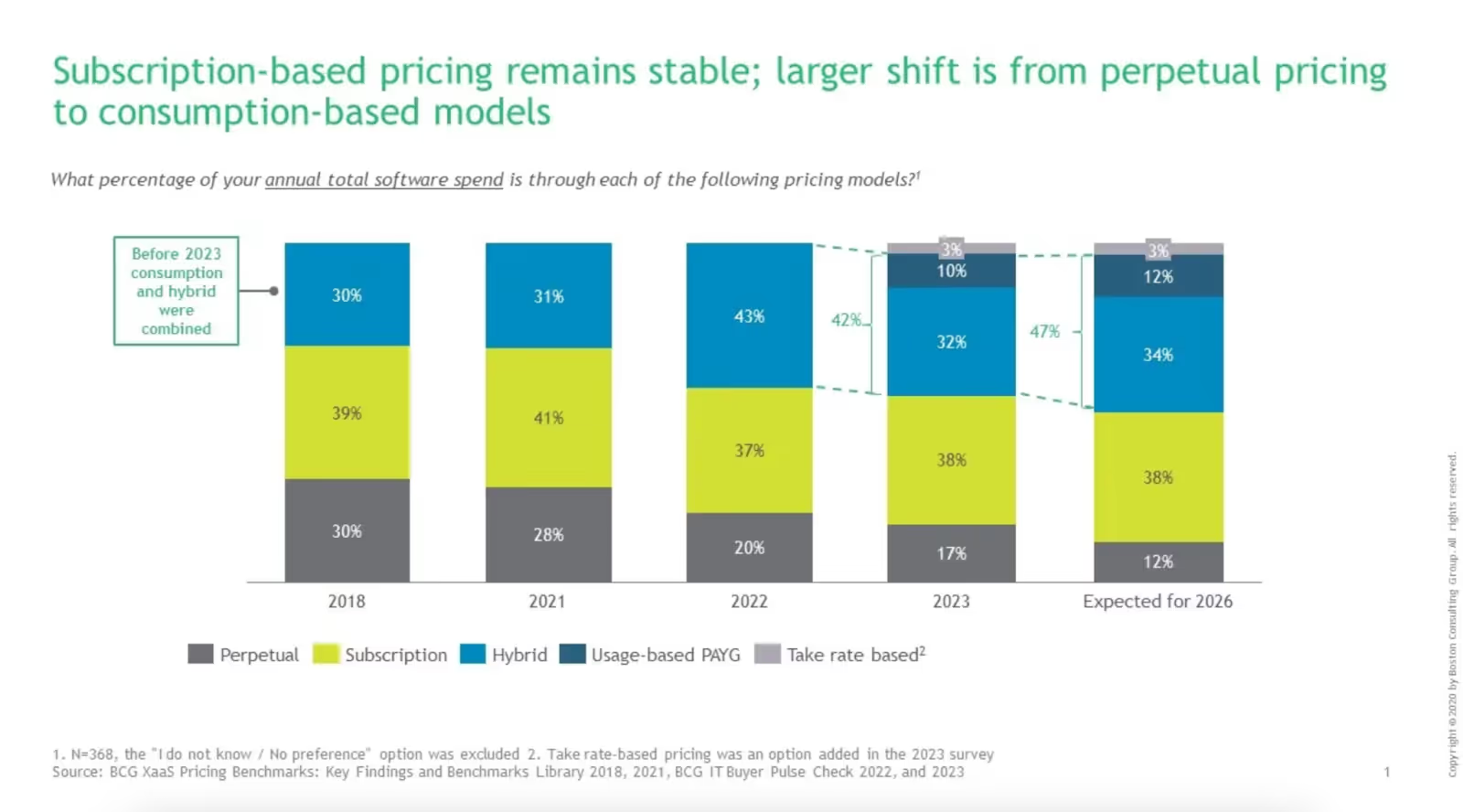
In the B2B space, the shift away from perpetual pricing toward hybrid and usage-based billing is well underway. IT buyers want flexible payment options and billing that reflects real-time product usage. That flexibility comes with complexity – and complexity requires the right infrastructure.
The reality of growth: what businesses often overlook.
Let's paint a picture. You're a startup with a handful of customers and a straightforward subscription management model. Life is good, right? Fast forward a year or two, and suddenly you're expanding into new markets, adding usage-based pricing tiers, maybe even considering an acquisition.
Sounds great for business, but have you thought about how your billing system will handle these changes?
If you're already using Enterprise Resource Planning (ERP) for billing or currently considering purchasing an ERP like NetSuite, think about how it will scale with your business. As you start to grow rapidly and suddenly, manual data entry, contract amendments and complex pricing models become harder to manage, and without the right system in place, a rising tide of billing errors and delayed cash flow are inevitable.
For example, you might be using NetSuite for basic invoicing, but as you get more customers or launch new products or services, you’ll need to navigate the twists and turns of billing and revenue recognition. This can’t be done effectively with manual processes or legacy systems because you’ll end up dealing with billing errors, manual data entry issues and delayed cash flow.
Growth brings more than just more transactions; it brings complexity in every facet of billing.
Many companies don’t realize this until it’s too late.
How growth exposes gaps in your NetSuite billing setup
Here’s a scenario that plays out more often than most finance teams expect.
You’re running subscription management through NetSuite with a manageable customer base and a straightforward pricing model. Then growth hits – a new market, a new product line, an acquisition. Suddenly the billing workflows you’ve been managing manually can’t keep up with the volume or the complexity.
If you’re evaluating how your ERP scales with billing complexity, the questions get specific fast: How does it handle contract amendments at volume? What happens when you add usage-based tiers or minimum commitments? How does revenue recognition hold up across multiple subsidiaries? Without the right setup inside NetSuite, the answer to each of those is “someone on your team handles it manually.”
Growth doesn’t just bring more transactions. It brings more variation, more exceptions and more opportunity for errors that compound quietly until they become a cash flow problem.
Top 5 growth scenarios and the billing challenges they bring
No two businesses grow the same way. But the billing problems that growth creates tend to follow recognizable patterns. These are the five that come up most.
1. Market expansion adds tax, currency and payment complexity
More than half of subscription businesses are planning international expansion within the next year. But entering new markets often means adjusting to local regulations, tax, currencies and accommodating customers who expect localized experiences – including their preferred payment methods. In fact, two-thirds of businesses plan to add at least one new local payment method in the next year to reach international customers and retain local subscribers.
If that work happens manually, finance teams end up checking tax treatment, exchange rates and invoice details outside the system. That creates room for billing errors and delays. It also makes reporting harder because the billing story is split between NetSuite, spreadsheets and local workarounds.
For NetSuite users, the target state is simple: billing changes should flow through the ERP workflow without forcing the team to rebuild the process for every new market.
2. Usage-based and hybrid pricing create billing exceptions
Nearly 70% of businesses expect to shift toward flexible models – like usage-based, tiered or hybrid pricing models. The common misconception is that usage-based pricing is simple. Multiply units by a rate. Job done. But as they start adding complexities like minimum commitments, overages or pooling usage across multiple customers, the billing challenges multiply.
When your billing models evolve, your billing system must be able to adapt. Without automation, your billing team will struggle to manually manage these changes and most likely face billing errors, delays and missed revenue opportunities, especially as your company scales.
Lattice saw this problem as its subscription offerings became more complex. Before ZoneBilling, multiple specialists spent four to five hours per day on manual billing work across NetSuite, Salesforce, Stripe and spreadsheets. After implementing ZoneBilling and ZonePayments, Lattice increased billing efficiency by 90% and reduced the work to less than two hours by one billing analyst.
3. Price increases in response to market conditions
Manually adjusting prices mid-contract is where billing errors cluster – wrong rates applied, revenue recognition delayed, customer-facing invoices inconsistent with contracts.
ZoneBilling customers use automated price adjustment workflows to handle mid-contract changes in real time, keeping billing accurate and revenue recognition on schedule.
“We chose Zone because of the level of customization that we knew we would have to do. We felt that ZoneBilling would be able to handle that customization with a higher degree of flexibility than maybe a more rigid tool.” – Sandro De Ciccio, VP Controller at Power Factors
4. Mergers and acquisitions: integrating multiple systems.
The appetite for M&As grew between 2025 and 2026, with 63% of CFOs stating they’re eager to undertake an M&A in 2026. Each acquisition brings a different billing setup, different customer records and different revenue recognition treatments.
One Power Factors customer faced this exact challenge after multiple acquisitions. Each company it acquired had its own billing system. By integrating ZoneBilling within its existing NetSuite environment, it merged all systems, standardized invoicing and reduced revenue booking time by 94%.
5. Customer growth: managing a growing customer base.
A telecom company that grew from $12 million to $100 million in revenue found its legacy billing setup inside NetSuite couldn’t keep pace. Usage fluctuations, renewals, cross-sells and up-sells were all managed manually. ZoneBilling’s dynamic pricing flexibility allowed it to manage complex pricing across customer segments and reduce billing time by 80% – giving each full-time employee capacity to manage $30 million in revenue, up from $4 million.
Is your NetSuite billing system ready to scale?
If you’re on NetSuite and your billing still relies on manual processes for anything beyond basic invoicing, these are the questions worth asking before growth forces the conversation:
- How does your billing setup handle a new pricing model mid-contract?
- What happens to revenue recognition when you double your customer base?
- How many hours does your team spend each month on contract amendments, billing corrections and chasing overdue invoices?
- Would you rather hire additional billing staff to absorb the volume, or automate from closed-won deal through invoice delivery?
Stripe found that 38% of businesses have lost deals because of inflexible billing systems and 52% are frustrated with the speed of their subscription processes.
Many businesses also deal with rising Days Sales Outstanding (DSO) – a direct consequence of manual order-to-cash processes that slow collections and create revenue gaps. When billing cycles are delayed or error-prone, cash flow suffers – and it affects reconciliation in NetSuite and reporting workflows later on.
How ZoneBilling handles growth complexity inside NetSuite
ZoneBilling is built natively inside NetSuite – not connected to it. There’s no middleware to maintain, no data syncing between systems, no reconciliation between your billing tool and your ERP. Everything runs in the same environment, on the same data.
Companies using ZoneBilling inside NetSuite report:
- 80% reduction in billing time
- 70% decrease in revenue recognition time
- Lower billing errors and reduced revenue leakage
- Improved cash flow and reduced DSO
- Better control, forecasting and financial visibility
Whatever billing model your business runs – one-time fees, subscriptions, tiered usage, minimum commitments, evergreen contracts or hybrid combinations – ZoneBilling handles it within your existing NetSuite environment. As your pricing strategy evolves, the configuration changes. Your billing system stays the same.
To see what the numbers look like for your business, use the ZoneBilling ROI calculator – enter your billing team size, salaries, error rates and annual revenue, and it returns detailed estimates of what automation would recover.
Book a demo today to unlock flexibility in your NetSuite billing and set up your finance team for growth.