
Over the last 18 months, your finance team stood up four AI agents. One reads invoices in accounts payable (AP). One runs purchase (PO) order matching. A third forecasts in financial planning and analysis (FP&A). A fourth handles procurement intake. Each one solves a real problem starting the week it went live, but none of them share a record, so data sits in four places, the audit trail spans three of them and the bill for all four keeps climbing.
This growing list of agents is called AI agent sprawl and is the point-solution problem finance has always faced, now with tools that make decisions. Every workflow gets its own agent, leaving finance to manage the integrations, reconciliation and audit gaps between them.
The alternative is one AI layer across the finance workflow, running on a single system of record. Every decision draws on the same data and lands in the same audit trail. Here’s how AI agent sprawl happens, what it costs and what consolidated AI looks like in practice.
Key highlights:
- AI agent sprawl happens when finance adds AI one workflow at a time, solving each immediate problem while creating new integration, data and audit gaps across the stack.
- The costs of AI agent sprawl are reconciliations that fail at month-end, licensing that compounds, a wider security surface and an audit trail broken across systems.
- The alternative is one AI orchestration layer across the full finance workflow on a single system of record: full context for every decision and one audit trail at close.
- Zoe is Zone's AI orchestration layer inside NetSuite. It coordinates AI across procurement, AP, reconciliation and reporting, so finance gets AI across the workflow without setting up a separate tool for each function.
What is AI agent sprawl?
Software sprawl is an old story. Every team buys the tool that fixes its problem, and a few years later no one can say how many systems finance touches. AI sprawl is worse, because these tools make decisions. When two of them code the same invoice or score the same vendor differently, the conflict lands in your ledger, and someone resolves it by hand before the books close.
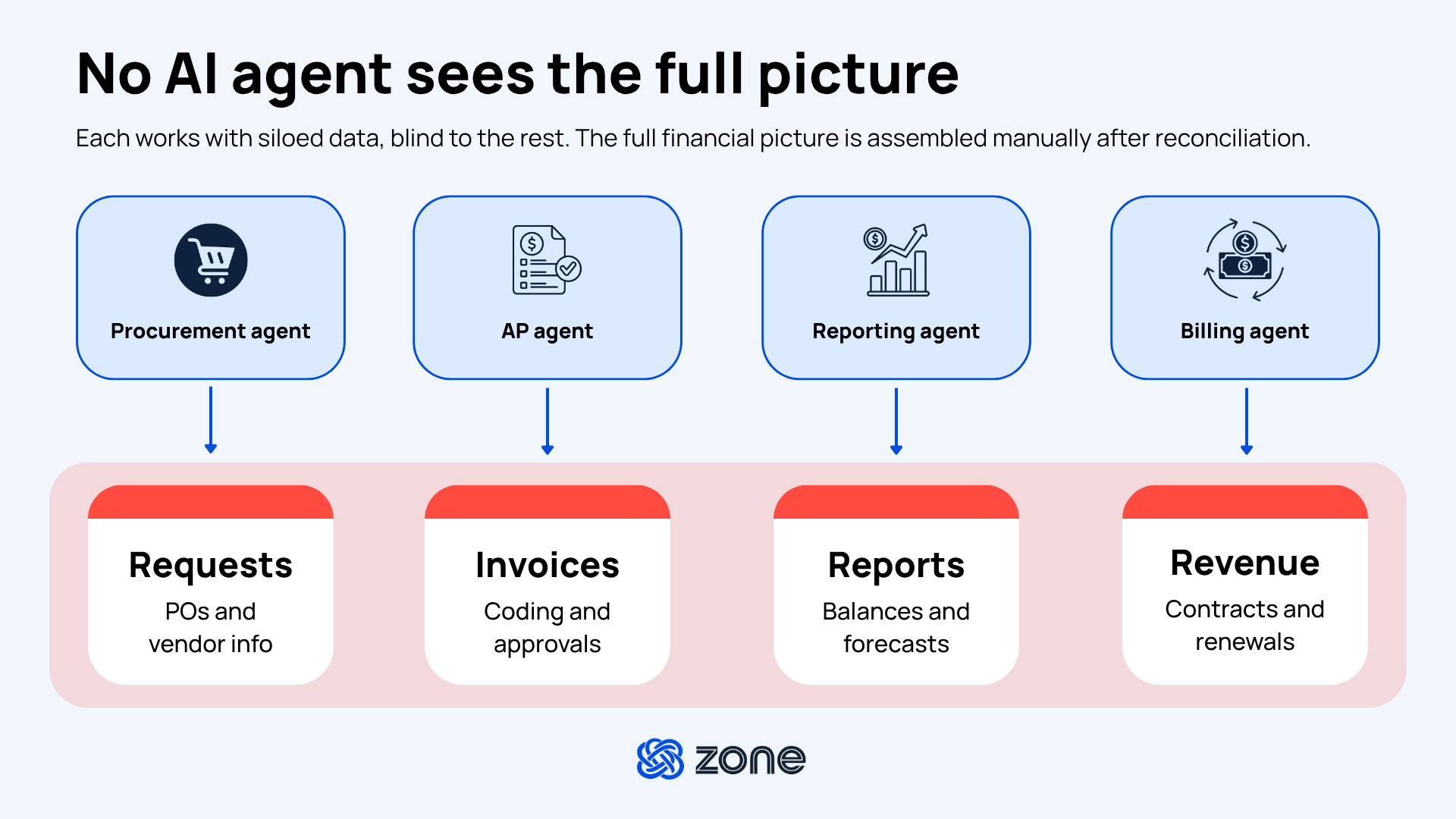
AI agent sprawl is the buildup of disconnected AI tools across finance, with each agent solving one workflow without shared data, rules or audit history.
That makes it more difficult to manage than ordinary software sprawl. Each tool works from its own slice of financial data, so two agents can evaluate the same transaction differently. Finance then has to reconcile the outputs because the systems underneath them don’t agree.
Picture two agents. Your procurement tool scores a vendor high-risk on one dataset while your AP tool, working from another, clears that vendor's invoice for payment – and neither knows the other made a call.
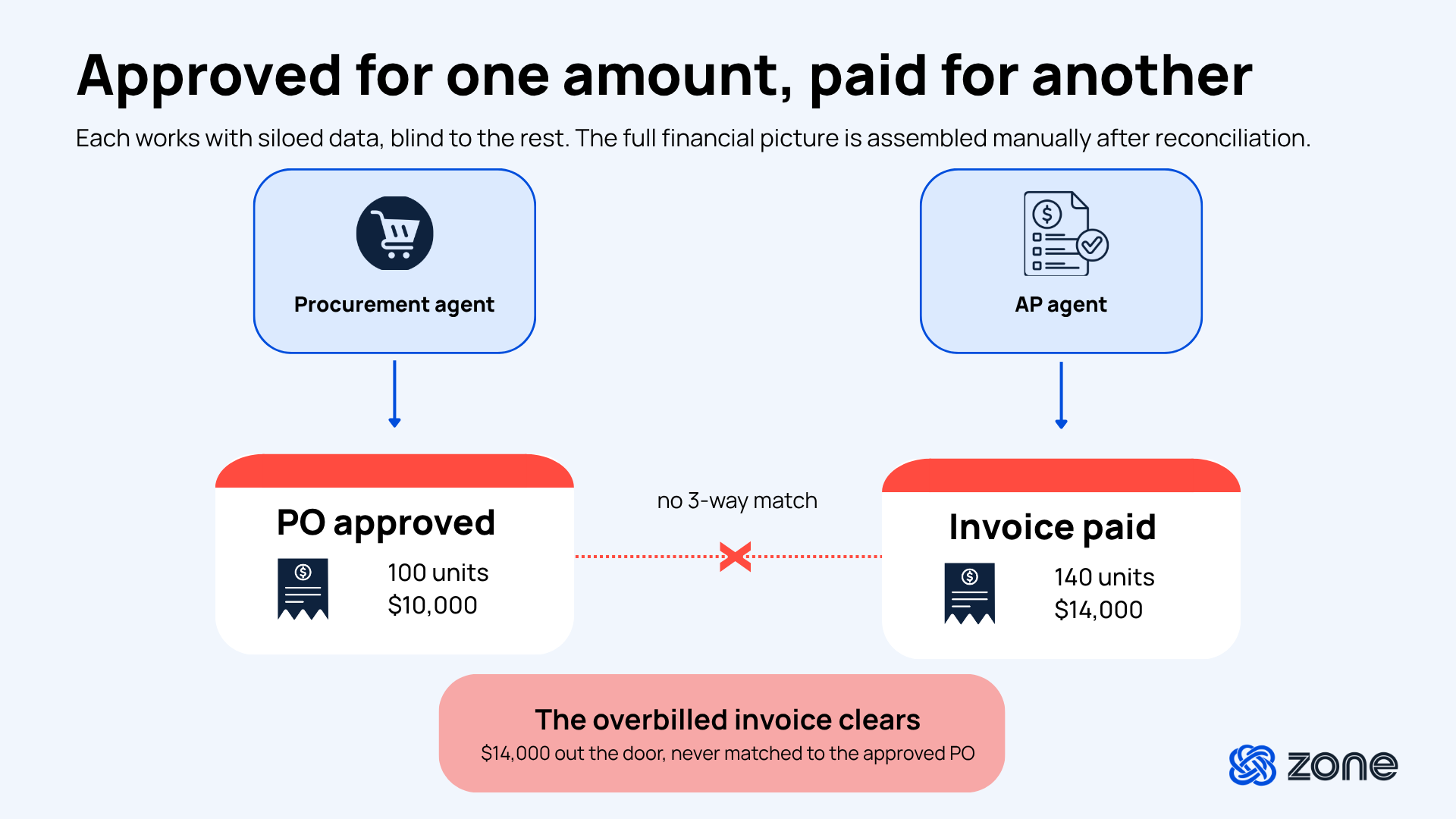
A mismatch can sneak through just as easily. Imagine your procurement tool approving a purchase order for 100 units, while the AP tool later codes and releases the vendor's invoice for 140. The overbilled invoice clears and a payment goes out that no one approved.
How AI agent sprawl happens in finance teams
Sprawl happens because transaction volumes climb, the pressure to adopt comes down from the board, budgets sit inside departments and the path of least resistance for finance automation AI is one tool at a time.
Each of these decisions is locally rational. The AP lead fixes AP, procurement fixes procurement and both are right to. What no one owns is the space between them, so every good local call adds one more connection for finance to maintain and one more gap to answer for at audit. It tends to build in the same order.
1. AI in accounts payable: one agent
It starts in AP, where the pain is loudest. Your team sets up an AI invoice capture tool. It reads PDFs and emailed invoices, codes them and pushes them into NetSuite on a sync schedule. For a while it's the best call finance made all year.
Then the vendor masters drift. The tool keeps its own list of vendors, NetSuite keeps yours and the two slowly disagree as names, terms and remit-to details change on one side but not the other. Duplicates appear. A vendor gets paid twice under two spellings. After six months, the sync breaks on a release update, and someone spends a close cycle reconciling what the tool thinks it sent against what NetSuite actually recorded.
2. AI for procurement: another agent
Procurement adds its own agent next. It captures purchase requests, routes approvals and gives the team a clean intake process. It's a genuine upgrade for procurement, and it has no link to the AP tool.
So the two halves of the same purchase never meet. An invoice lands in AP with no thread back to the request procurement already approved, the budget it was checked against or the vendor record procurement onboarded. Three-way matching, the one procure-to-pay control that ties a PO to a goods receipt to an invoice, drops back onto a person who opens both tools and matches them by hand.
3. AI for reporting: one or more agents
Reporting is where the cracks reach the CFO. Finance adds an AI reporting tool that pulls from NetSuite over an API and produces clean dashboards on a schedule.
The trouble is the data it pulls hasn't been reconciled by the AP or procurement agents upstream, so the numbers on the dashboard sometimes disagree with what the team knows is true. A board slide shows one AP balance, the ledger shows another. Once a controller catches that gap twice, trust in the reporting drops and finance goes back to rebuilding the numbers by hand for anything headed to the board.
4. AI for subscription billing: one more agent
Then the revenue side wants in. Billing adds an AI agent to manage subscriptions, usage tiers and renewals, and it lives outside the ledger like the rest.
Now the contract terms the billing agent works from can drift from the revenue schedule in NetSuite, so a renewal or a mid-cycle change updates in one place and lags in the other. Revenue recognition becomes a reconciliation between the billing tool and the books, the exact manual work the agent was bought to remove. If you're weighing tools here, our rundown of subscription billing platforms shows how much of this depends on where the billing logic runs.
The hidden costs of disconnected AI in finance
Each agent's subscription looks fair on its own renewal date. The cost of the whole set is the part no one adds up before adoption. Finance is the one that pays it later.
Data silos and reconciliation failures
Every agent runs on its own data model, so when their outputs have to agree at month-end, at audit or in a board pack, the reconciliation falls to your team. The AI that was supposed to give time back creates more work in resolving conflicts between tools working from different data.
In Zone’s “AI Impact vs. Hype in Finance” 2026 report, of the finance professionals surveyed, 43% said that when AI underdelivers, the result is more work to correct or reconcile data, and 38% said AI saves some time but adds new admin work.
The issues show up as:
- Duplicate or late payments that slip through when no single tool sees the whole vendor picture
- Balances that don't tie between a reporting agent and the ledger it pulled from
- Exceptions that each agent leaves for a person to resolve
- A month-end that turns into a reconciliation of your tools before you can reconcile the books
The bill for this is a month-end close that runs two days long, and a controller who spends the first week of every month deciding which of four systems to believe.
Compounding licensing costs
Per-tool pricing looks modest one line at a time, but it compounds fast. A $50,000 AP agent, a $30,000 procurement agent and a $40,000 forecasting agent for annual use adds up to $120,000 in yearly subscription bills.
The renewal number leaves out much of the real cost of ownership:
- Implementation and integration for each tool, paid again every time you add one
- Sync maintenance, which becomes someone's recurring job the first time a connection breaks
- The internal time to manage three or four vendor relationships and renewals
By the third or fourth agent, the line you’re renewing can be smaller than the internal cost of keeping the set connected.
Security and audit risk
Every agent is another door into your financial data. It’s another set of credentials, another vendor security review and another entry in the audit log. For a team with SOX, PCI or ISO obligations, each tool widens the attack surface and splinters the audit trail.
What if an auditor asks for the full approval history on a single invoice? The request came through the procurement agent, the approval routed through a second tool, the payment cleared through NetSuite and the AI coding decision sits in a fourth log. Reconstructing one invoice's story means pulling from four places and hoping they agree.
The number the board sees is only as defensible as the trail behind it, and a trail assembled from four tools at quarter-end is a hard one to stand behind.
When AI tools create more reconciliation, integration and audit work, adding another point solution won’t solve the problem.
What consolidated AI looks like for finance
The fix is to consolidate AI around a single system of record, so every AI decision is made with full context, logged in one place and open to audit without a reconciliation step first. Consolidation comes down to where the AI runs. The number of tools is a separate question.
That's what AI orchestration in finance means in practice: one data layer and one control layer, with each workflow's AI reading from the same NetSuite records. It's also how you contain the risk in agentic AI for finance, giving agents that act on their own one place to be governed, logged and checked.
Consolidated AI means one data source, one vendor master, one audit trail and one connection to secure. Orchestration adds shared context across the workflow, which is something disconnected agents can’t provide.
That changes how information moves through finance:
- Context carries forward. A purchase request brings its vendor, budget and approval history into invoice capture.
- Decisions stay attached. Coding and approval records follow the transaction into reconciliation.
- Reporting inherits trusted data. The figure shown to the board comes from the same reconciled record finance used at close.
- The audit trail stays intact. Each step inherits the record from the one before it, preserving the story of every number from intake to close and giving auditors one connected record to trace.
The further teams get with ERP-native AI, the more they trust it. In Zone's report, 87% of broad adopters are confident in AI embedded inside the ERP, compared with 39% of teams still in pilots. Ownership follows the same pattern. Where no one owns the AI, only 9% of teams report positive ROI. Where finance leadership owns it, 46% do. One layer on one system is also one thing to own.
Consolidation also changes what your team does with its time. When reconciliation and audit work stop consuming the first week of the month, that capacity goes back to forecasting, investigating variances and helping the business make its next decision.
How Zone unifies AI across the NetSuite finance stack
Agentic AI in finance raises one hard question: who governs the agents? Zone's answer is Zoe, the orchestration layer inside the Zone platform on NetSuite. Zoe coordinates the agents already working across your Zone workflows, so they run on one set of records and one audit trail.
Across Zone's platform, that coordination reaches the workflows where finance spends its day, for example:
- Procurement intake and vendor onboarding through ZoneProcure, bringing those processes into the same NetSuite records used by AP, reconciliation and reporting to improve spend visibility.
- Invoice capture and GL coding through ZoneCapture, reading from the same vendor master the rest of the stack uses, with every AI action logged and a person as the final approver.
- Approval routing through ZoneApprovals, so the sign-off history stays on the transaction.
- Reconciliation and exception handling through ZoneReconcile, matched against the same records reporting reads from.
- Cash forecasting, drawing on the reconciled NetSuite data the rest of the stack already trusts.
What counts is that all of it runs on one system of record, one set of data and one audit trail, inside NetSuite. The result is AI the team can govern, with one place to check what it did. Zone calls the end state Finance as a System of Agency™. It’s finance that acts on its own data with full control, where NetSuite stays the system of record and Zone is the system of agency on top of it.
Which brings it back to the four agents you started with. Each solved a real problem, but each one left a gap that finance has to close by hand. The choice from here is simple: keep adding disconnected tools, or run one AI layer on the record where your numbers already live.
Book a demo to see how Zone runs that one layer across your finance workflow inside NetSuite.
Zone & Co strategically uses AI to research and draft articles, but the final version is shaped by people. Our team carefully reviews content with multiple human-in-the-loop steps in the process to ensure accuracy, relevance, tone and alignment with readers’ interests.