

The contract is signed and the sales team is working on the next opportunity, but somewhere between the customer relationship management (CRM) and the enterprise resource planning (ERP) platforms, someone is rebuilding the order details by hand. They’re re-entering line items, reconciling discount logic and checking whether the invoice matches what the customer actually agreed to. When it goes out late or wrong, the damage ripples from accounts receivable (AR) all the way to close.
Quote-to-cash software and automation can break that cycle, but you have to choose the right one. Tools that look capable in a demo often hand the reconciliation problem back to finance the moment a contract gets amended or a billing model doesn’t fit the template. The teams making real progress on CRM-to-ERP automation are choosing Q2C solutions that stay connected to the ERP from contract creation through revenue recognition, with control logic built in before the first invoice runs.
Key highlights:
- Quote to cash software should eliminate the data handoff gap between CRM and ERP, not just speed up individual steps inside each system.
- CRM-to-ERP automation requirements include contract amendments, invoicing edge cases and revenue schedule linkage to reduce revenue leakage risk.
- Software features that prevent revenue leakage depend on ERP-native billing logic, not on middleware that syncs after the fact.
- ZoneBilling workflows deliver CRM-to-ERP orchestration inside NetSuite, where billing, rev rec and approval controls run in one governed environment.
Common problems that Q2C software should solve for finance
Q2C software evaluations might start with the question “Which platform covers the most use cases?” But the more important question is “Where does our current workflow fail, and which failure is costing us the most?” Here’s where quote to cash software breaks down most consistently in mid-market and enterprise finance environments.
Quote data that never arrives clean
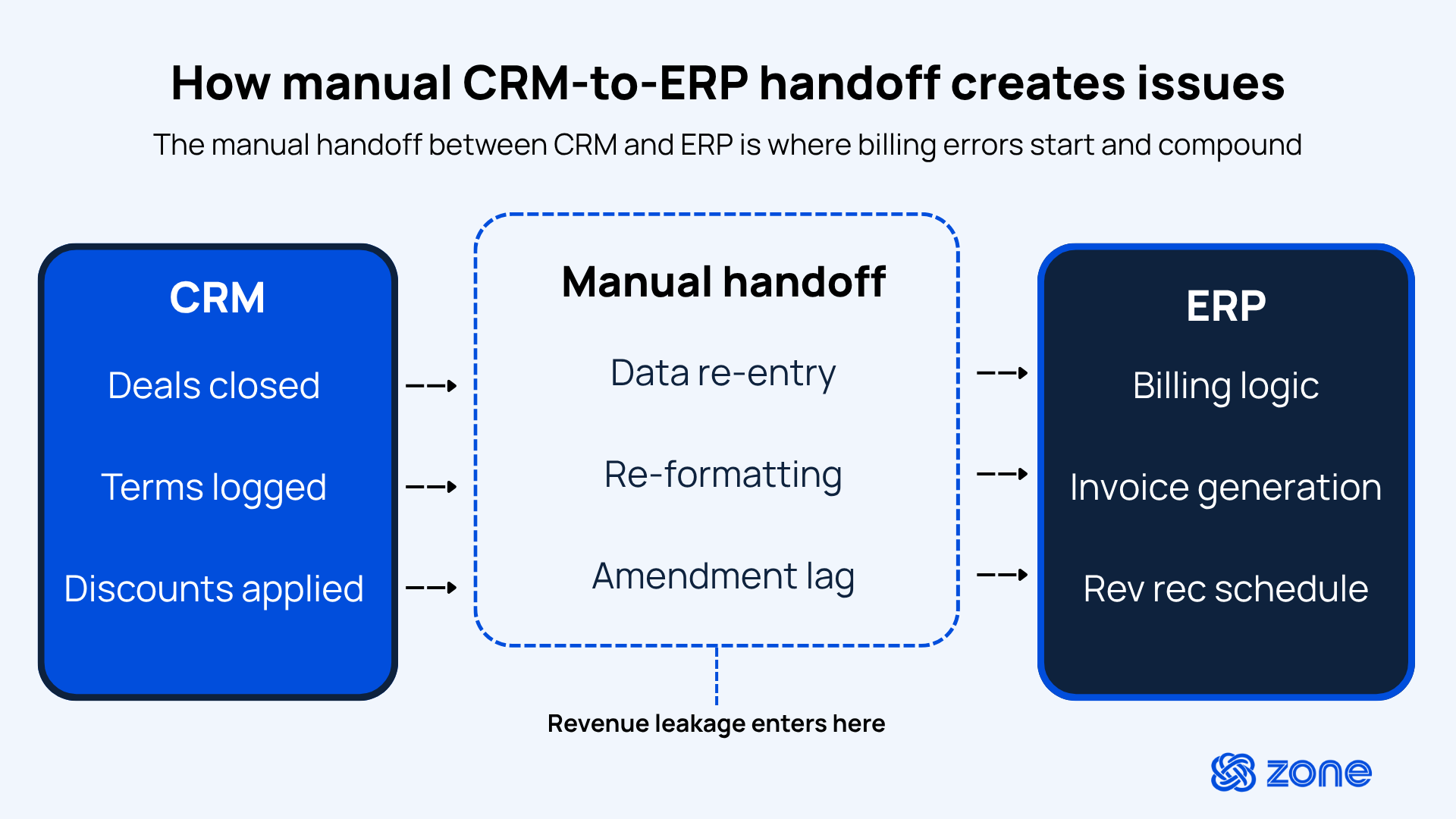
Sales closes a deal and logs the order details in the CRM. Someone in sales, administration or revenue operations could re-enter, reformat or summarize the data before finance gets a chance to see it. Now the version finance is billing against doesn’t match what the customer signed.
Strong Q2C software solves this by treating the CRM as a data source the ERP reads directly, not a system that sends emails or exports. Contract terms, pricing structures, start dates and discount logic flow into the billing workflow without manual re-entry. The invoice reflects the contract the customer agreed to.
Invoicing that waits on manual handoffs
A billing run that depends on a finance team member pulling data from a deal sheet, cross-referencing a CRM record and building an invoice in the ERP is a billing run that will sometimes be late, sometimes be wrong and will always take longer than it needs to.
Quote-to-cash solutions that automate invoice generation from contracted terms remove the manual assembly step. The system knows what to bill, when to bill it and which payment terms to apply. because those decisions were made at the contract stage, not reconstructed at billing time.
Amendment logic that breaks mid-contract
Upgrades, downgrades, seat changes and mid-cycle pricing adjustments are common in SaaS billing. They are also where most manual Q2C workflows fail, because the amendment creates a new commercial reality that the billing system wasn’t originally configured to handle.
If amendments require someone to rebuild the billing logic by hand, the software isn’t helping. Finance teams should consider Q2C software that processes prorated adjustments, updated revenue schedules and revised invoices automatically.
Billing models the system can’t represent
You might have a customer contract that includes a recurring base fee, a usage-based overage charge, a professional services milestone and an annual true-up. A billing system that was built for straightforward subscription billing will mishandle at least one of those. In fact, straightforward, flat-fee billing is phasing out. According to the most recent McKinsey research, usage-based billing accounted for 74% of revenue for high-growth companies.
Revenue accounting leaders evaluating Q2C software should map their actual billing model complexity against the system’s configuration options before selection, not after go-live. A native solution that runs inside the ERP writes directly to the same records used for everything else — which means the revenue schedule, the invoice and the general ledger entry stay aligned from the start.
Revenue recognition that runs separately from billing
Revenue recognition and billing address different questions (what to invoice versus what to recognize), but they draw from the same source. When the two systems run separately, finance spends period-end reconciling the gap between what was billed and what should be recognized.
Quote-to-cash software that keeps billing and rev rec inside the same ERP environment removes that reconciliation step. The performance obligation schedule is built from the same contract data the invoice draws on. There is no sync to run and no version mismatch to resolve.
CRM-to-ERP automation requirements buyers miss
Finance teams evaluating CRM-to-ERP automation tend to focus on what the integration covers at steady state: standard subscriptions, recurring invoices, clean renewal cycles. The requirements that matter most — and that buyers consistently underweight — are the edge cases that happen every quarter. Four of them account for the majority of downstream billing and revenue errors.
Contract data sync
Contract data sync is the connection that carries CRM deal information into the ERP billing workflow – including every change made after the contract is signed.
- Why you should require it: Most systems handle initial deal creation accurately, but fail on contract data syncs when a customer renegotiates pricing, extends a term or adds a product mid-cycle. A real-time sync triggers workflows to update pricing and models based on your configurations automatically.
- What happens if you don’t have it: The updated contract terms don’t reach the billing system automatically. A finance team member reconciles the difference manually by finding the discrepancy, tracing the change and correcting the invoice.
Amendments
An amendment is any mid-contract change like pricing, term or product configuration that affects what the customer owes and when revenue can be recognized.
- Why you should require it: Amendment processing should calculate proration automatically, update the revenue schedule in the same transaction and maintain a full change history an auditor can review. A system that does all three removes the most common source of billing errors from the close cycle.
- What happens if you don't have it: Finance answers the amendment questions manually — usually at month-end, usually under deadline pressure. Proration gets calculated in a spreadsheet, rev rec gets adjusted separately and the audit trail is whatever the team managed to document at the time.
Invoicing logic
Invoicing logic is the set of rules that governs how and when an invoice is generated based on configurable settings.
- Why you should require it: Finance should be able to configure invoicing logic without developer support for each new billing scenario. A system that gives finance that control can handle complexity without requiring an implementation consultant every time something changes.
- What happens if you don’t have it: The finance team works around the system’s limitations by manually calculating charges the tool can’t rate, splitting invoices the tool can’t consolidate and logging support tickets for billing configurations that should be self-service.
Rev rec linkage
Rev rec linkage is the connection between the contract terms that drive invoicing and the performance obligation schedule that governs revenue recognition.
- Why you should require it: When billing and rev rec draw from the same contract data inside the ERP, the revenue schedule updates automatically when the contract changes. Finance can review a system that keeps the two aligned with no manual reconciliation step required at close.
- What happens if you don’t have it: Finance manually maintains the link between the billing schedule and the rev rec schedule across every contract amendment. When the two drift apart — and they will — the reconciliation work happens at close, when the team has the least time to absorb it.
The software features that prevent revenue leakage
Revenue leakage in Q2C workflows is usually caused by correct contracts with incorrect invoices; it’s the gap between what a customer agreed to and what finance actually billed. Strong quote-to-cash software closes that gap with these capabilities:
- Automated invoice generation: Every invoice is generated directly from the active contract record without a finance team member rebuilding the billing logic at run time. If the contract says $4,500 per month, starting the 15th, net-30, that’s exactly what bills.
- Proration calculation: When a customer upgrades mid-cycle, the system calculates the prorated adjustment and applies it to the next invoice automatically. Teams handling this in spreadsheets introduce rounding errors and inconsistent methodologies across accounts.
- Usage-based billing and rating: For billing models tied to API calls, active seats, storage or transaction volume, the system ingests usage data from its source, applies the contracted rate and calculates the overage automatically. A system that requires finance to receive a report, calculate the charge and enter it manually isn’t automating usage billing – it’s documenting a manual process.
- Amendment processing with audit history: Every contract change produces a dated record showing what changed, when and what the downstream billing consequence was. This is the information finance needs when a customer disputes an invoice 12 months after an amendment.
- Revenue schedule integrity: When a contract changes, the system updates the invoice and the rev rec schedule from the same event. A system that updates one but not the other creates a reconciliation problem every time an amendment is processed.
A quote-to-cash software scorecard for evaluating vendors
Evaluating quote-to-cash software on features alone produces a shortlist of tools that all look capable in demos and perform differently in production. The scorecard below gives finance leaders a framework for evaluating vendors on the dimensions that affect controllership, auditability and operational ownership.
Automate your CRM-to-ERP quote-to-cash workflow with ZoneBilling
Q2C software evaluations result in the realization that billing needs to run inside the ERP, not alongside it. CRM-to-ERP automation that depends on middleware introduces sync delays, version mismatches and inefficient reconciliation steps.
ZoneBilling was built inside NetSuite so billing logic, revenue recognition schedules and approval workflows all operate inside the ERP, drawing from the same contract data and writing to the same general ledger. No export, no sync and no reconciliation needed.
For finance teams managing complex billing models, ZoneBilling handles flat-rate subscriptions, usage-based charges, professional services milestones and hybrid models in one configuration. Amendments update the billing schedule and the rev rec schedule from the same contract event. Invoices generate from contract terms without manual assembly. And the audit trail – approvals, amendment history, invoice versions – lives inside NetSuite.
Book a demo today to see how ZoneBilling supports Q2C automation with NetSuite.