
Revenue accountants at SaaS companies have had years to understand the ASC 606 five-step model, and most teams have the policies to prove it. But as contract volume grows and pricing models get more complex, the compliance risks are from contract modifications that arrive on day 28, standalone selling price (SSP) allocation methodologies applied differently across similar deals and deferred commission schedules living in spreadsheets two systems removed from the recognition tool.
This guide is for controllers and revenue accountants wrestling with how to operationalize ASC 606 at scale in NetSuite. Beyond the five-step model, it covers the compliance pitfalls where teams most commonly break down, the disclosure requirements auditors focus on, the contract cost accounting framework that runs parallel to revenue recognition and what a practical month-end close workflow actually looks like.
Key highlights:
- ASC 606 applies a single five-step model to nearly all revenue contracts across industries
- The biggest compliance risk is operational, not conceptual – multi-element arrangements and contract modifications are where manual processes fail
- ASC 340-40 governs contract cost capitalization and runs parallel to ASC 606 – most guides leave this out
- A disciplined month-end close workflow is what separates teams that pass audits from teams that don't
- ZoneBilling automates ASC 606 recognition schedules natively inside NetSuite, eliminating spreadsheet-based rev rec
What is ASC 606?
ASC 606, or Accounting Standards Codification Topic 606, is the revenue recognition standard issued by the Financial Accounting Standards Board (FASB) that replaced a collection of industry-specific rules with a single, principles-based framework. It took effect for public companies in fiscal years beginning after December 15, 2017, and for private companies in fiscal years beginning after December 15, 2018.
The core principle is that companies recognize revenue to depict the transfer of promised goods or services to customers in an amount that reflects the payments they expect to receive. This replaced ASC 605, which relied on industry-specific guidance and allowed significantly different accounting outcomes for economically similar arrangements.
Who must comply with ASC 606?
Any entity that enters into contracts with customers to transfer goods or services is subject to ASC 606. That covers virtually every revenue-generating business operating under U.S. GAAP (Generally Accepted Accounting Principles). The standard's impact is most significant for industries with complex arrangements, such as:
- SaaS and software companies: Multi-element arrangements that include implementation and support, variable pricing, usage-based billing models
- Professional services: Milestone-based recognition, bundled deliverables
- Construction and real estate: Over-time recognition, pricing that can change based on performance or outcomes
- Telecommunications: Contracts with equipment and service bundling
IFRS 15 is the international equivalent under International Financial Reporting Standards, using the same five-step framework with some differences in application guidance and disclosures. For multinational companies, both standards generally produce the same recognition outcomes.
ASC 606 vs. ASC 605
The two standards share the same goal but take fundamentally different approaches to reaching it. Here's how they compare across the factors that matter most in practice.
The ASC 606 five-step model
The five-step model is the framework for determining when and how much revenue to recognize for any customer contract.
Step 1: Identify the contract with the customer
A contract exists under ASC 606 when all five criteria are met:
- Both parties have approved it
- Each party's rights regarding goods or services are identifiable
- Payment terms are identifiable
- The contract has commercial substance
- It is probable the entity will collect the consideration it is entitled to
Contracts can be written, oral or implied by customary business practice and contract modifications matter at this step. When a contract changes, the entity must assess whether the modification creates a new contract, modifies the existing one or terminates the existing contract and creates a new one – with different revenue implications for each treatment.
Step 2: Identify the performance obligations
Performance obligations are the distinct goods or services promised in the contract. Two questions determine whether an obligation is distinct: Is the good or service capable of being distinct on its own, and is it distinct within the context of the contract?
A SaaS contract that includes software access, implementation services and 12 months of dedicated support likely has three separate performance obligations, each with its own recognition timing:
- Software access is recognized over the subscription term.
- Implementation is recognized when services are completed.
- Support is recognized ratably over the support period.
Getting this step right is critical because it determines how the transaction price is allocated and when each piece of revenue hits the income statement.
Step 3: Determine the transaction price
The transaction price is the amount you expect to get paid for delivering on the contract. For fixed-price deals, that's straightforward. It gets difficult when pricing isn't certain upfront – usage-based charges, performance bonuses, discounts or penalties that depend on future outcomes all require estimation.
You can only include those estimates in revenue if you're highly confident you won't have to reverse them later. That judgment call – known as the variable consideration constraint – is one of the most scrutinized areas of the standard, and one where teams most commonly over- or under-correct.
Step 4: Allocate the transaction price
When a contract includes multiple performance obligations, the transaction price is allocated to each based on its standalone selling price (SSP) – the price at which the entity would sell that good or service separately to a similar customer.
Three estimation methods are available when observable SSP data doesn't exist:
- Adjusted market assessment approach: Estimate what the market would pay for the good or service separately
- Expected cost plus margin approach: Estimate the cost to deliver, then add a reasonable margin
- Residual approach: For highly variable or uncertain pricing, allocate the residual transaction price after all other obligations are priced
The choice of method affects how revenue is distributed across obligations and must be applied consistently across similar contracts.
Here’s an example:
A $120,000 annual contract value (ACV) SaaS contract includes software access, a three-month implementation project and 12 months of priority support. Using SSP data, the allocation would break down as:
Those three recognition schedules run simultaneously, each on its own timeline.
Step 5: Recognize revenue when or as performance obligations are satisfied
Revenue is recognized at the point in time when control transfers (for point-in-time obligations) or ratably over the performance period (for over-time obligations). Five indicators support over-time recognition:
- The customer simultaneously receives and consumes the benefits as the entity performs
- The entity creates or enhances an asset the customer controls
- The asset has no alternative use and the entity has an enforceable right to payment for performance completed to date
- The entity's performance does not create an asset with alternative use
- The entity has an enforceable right to payment for performance completed to date
For most SaaS contracts, software access and support satisfy the first criterion – the customer is consuming value continuously. Implementation typically satisfies obligations at a point in time, though percentage-of-completion methods are appropriate for longer, more complex engagements.
Three treatments in contract modification accounting
Contract modifications are one of the most consistently under-documented areas of ASC 606 compliance. A customer upgrading their tier mid-term, adding a seat, extending a contract at a new rate or reducing scope – each is a modification and requires an assessment before the close period it occurs in.
There are three possible treatments, and choosing the wrong one produces a material misstatement:
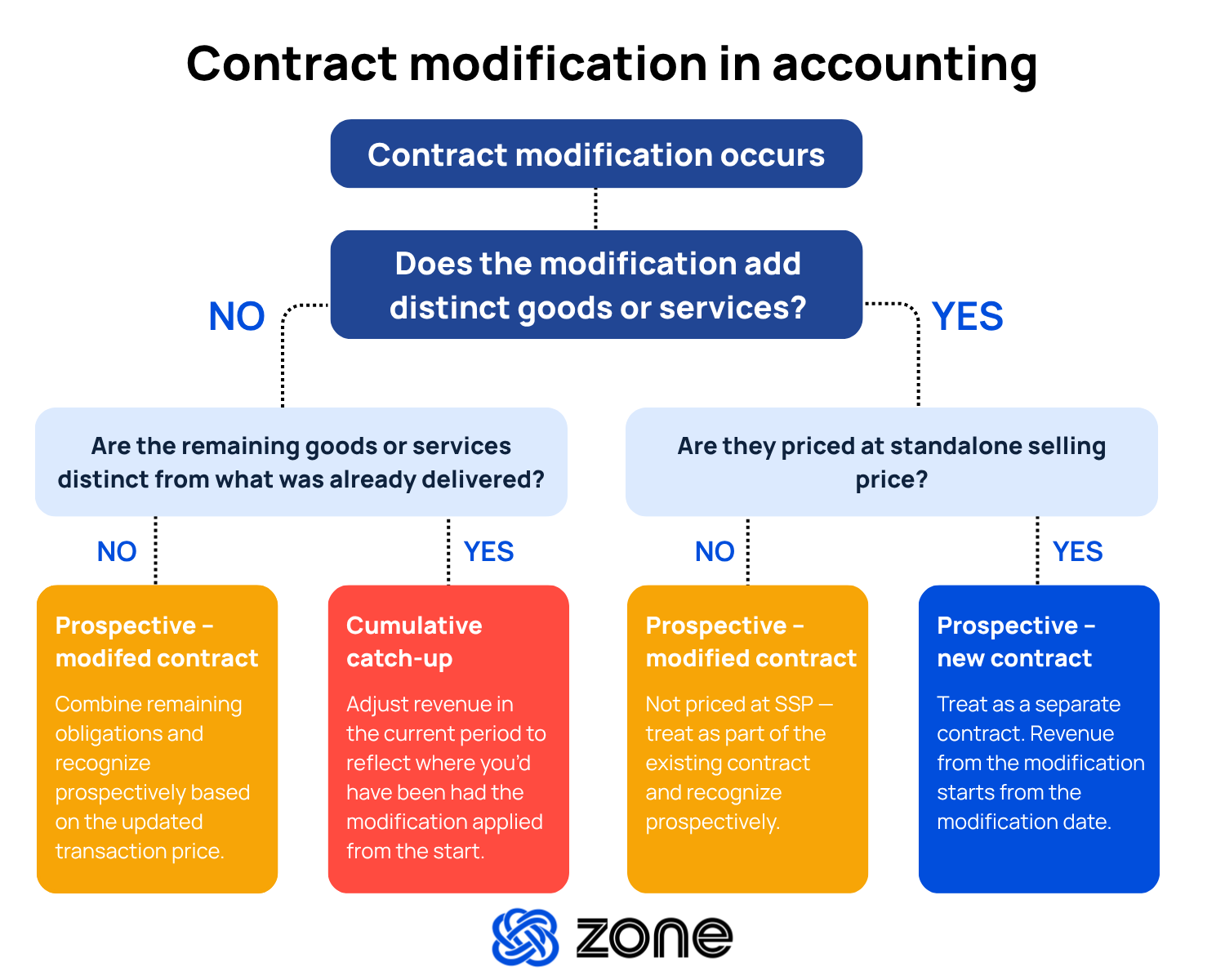
- Prospective treatment (new contract): When the modification adds distinct goods or services at a standalone selling price, it is treated as a new contract. The existing contract is unchanged. Revenue from the modification starts from the modification date.
- Prospective treatment (modified contract): When the modification adds goods or services that aren’t distinct or are priced at a discount, the remaining goods and services are treated as a combined performance obligation. Revenue is recognized prospectively based on the updated transaction price divided by remaining performance.
- Cumulative catch-up: When the remaining goods and services are distinct from what was already delivered, the entity adjusts revenue in the current period to reflect the position it would have been in had the modification been in place from the start. This is the treatment most likely to be missed when modifications arrive late in a close cycle.
The documentation requirement is significant. Common audit findings relate to inconsistent application of SSP methodology across similar deals, inadequate documentation of performance obligation judgments and modification accounting that doesn't match the standard's requirements. When modifications are handled manually, the assessment is often made by whoever catches it – with no consistent methodology applied.
AI revenue recognition and billing software handles these treatments. When a modification is logged in the billing system, the recognition schedule updates automatically in the current period with the correct treatment applied according to configured rules.
Variable consideration: Where over-correction creates its own risk
Applying the variable consideration constraint is one of the most common places teams get tripped up under ASC 606 – and the problem runs in both directions. Over-estimate and you're pulling forward revenue you'll have to reverse. Under-estimate and you're understating recognized revenue.
- Under-constraint: A company estimates that a performance bonus will very likely be achieved and includes the full amount in the transaction price, then the bonus falls through. Revenue must be reversed and that reversal is material. Auditors flag the methodology as insufficiently conservative.
- Over-constraint: Some teams, trying to play it safe, hold back all variable revenue until they're 100% certain they'll receive it. But that's not what the standard requires. ASC 606 doesn't say "wait until you're certain" – it says "include the estimate as long as a significant reversal is highly unlikely." Waiting for certainty is actually non-compliant, just in the opposite direction from being too aggressive.
Both KPMG's 2025 Revenue Recognition Handbook and the FASB's November 2024 Post-Implementation Review flag variable consideration estimation as one of the most judgment-intensive areas of the standard – and the one most likely to draw auditor scrutiny.
Three practices keep variable consideration compliant at scale:
- Document the methodology, not just the estimate. Auditors reviewing variable consideration want to see a repeatable framework – expected value or most likely amount, the evidence base for the probability assessment, and a policy for when to reassess.
- Set a reassessment trigger. Any new contract, modification, or external signal that changes the probability distribution is a reassessment event. The methodology should specify what triggers a reassessment and who is responsible for it.
- Track constrained amounts separately. The amount excluded from the transaction price by the constraint needs to be tracked so it can be recognized when uncertainty resolves and the constraint lifts.
ASC 340-40: The contract cost framework that runs alongside ASC 606
Most revenue recognition guides only cover when to record revenue. ASC 340-40 covers the other side of the same contract – what to do with the costs you incurred to win and deliver it. For SaaS companies, that mostly means sales commissions and implementation costs.
If you paid a commission to land a contract, that cost has to be spread out over the period you expect to benefit from that customer – not expensed immediately. For most SaaS companies, that period is longer than the initial contract term because customers typically stick around for three to four years.
Sales commission capitalization
ASC 340-40 includes a shortcut that lets you expense commissions immediately if the benefit period is a year or less. Most SaaS companies can't use it. These are the three accepted methods for calculating the amortization period:
- Cohort-based estimate: Use historical churn data to compute average customer tenure. Most defensible in audit.
- Contract-based approach: Amortize over the initial contract term, with renewal commissions recognized over the renewal period. Simpler but may understate the asset if renewal rates are high.
- Portfolio approach: Apply a blended amortization rate across a portfolio of similar contracts. Acceptable where individual contract-level tracking would be impractical.
The practical problem is tracking. If commission data lives in a customer relationship management (CRM) system or separate commission tool that isn't connected to your recognition system, you end up rebuilding it in a spreadsheet every close cycle – a reconciliation risk every period.
Implementation cost capitalization
Implementation and setup costs can be capitalized if they meet three criteria:
- They relate directly to a specific contract
- They generate or enhance resources used to satisfy future performance obligations
- You expect to recover them through the contract
Costs that would have been incurred regardless of the contract – general overhead, idle capacity – are expensed immediately. Implementation costs that create a distinct asset the customer controls may fall under ASC 350-40 or ASC 985-20 rather than ASC 340-40, which affects both the capitalization criteria and the amortization period.
Why this matters for compliance
ASC 340-40 errors and ASC 606 errors compound. If you're understating your deferred commission asset and also being too conservative on variable consideration, you have two mistakes running in opposite directions – both rooted in the same contract, both being reconciled in separate spreadsheets at period-end. That combination is what leads to restatements.
ASC 606 disclosure requirements
ASC 606 requires significantly more disclosure than its predecessor. The five primary requirements:
- Disaggregated revenue: Revenue broken down by type of good or service, geographic region, market segment or contract type – whatever provides the most useful disaggregation for financial statement users.
- Contract balances: The opening and closing balances of receivables, contract assets and contract liabilities (deferred revenue), plus the relationship between those balances and revenue recognized during the period.
- Remaining performance obligations: The aggregate transaction price allocated to unsatisfied obligations and the expected recognition timeline. Private companies with contracts of one year or less may use the practical expedient to exclude short-duration contracts from this disclosure.
- Significant judgments: Disclosure of the judgments made in applying the five-step model – how and when performance obligations are satisfied, how SSP is determined, how variable consideration is constrained.
- Contract cost assets: The opening and closing balances of capitalized contract costs under ASC 340-40, amortization for the period and any impairment recognized.
These disclosures are what auditors focus on. When recognition schedules are maintained manually in spreadsheets, producing compliant disclosures requires aggregating data from multiple sources. When revenue recognition is automated in your enterprise resource planning (ERP) system and connected with your CRM, disclosures populate from the same data that drives journal entries. The audit trail exists by design, not by reconstruction.
What auditors actually scrutinize
Auditors reviewing ASC 606 compliance spend the most time on four areas:
- SSP methodology consistency. Auditors ask for the methodology behind each allocation, then test whether similar contracts received the same treatment. Inconsistency across the portfolio – not any single calculation – is a common finding.
- Variable consideration documentation. The constraint is a judgment call. Auditors want to see a documented methodology, a clear evidence base for the probability assessment and evidence that the assessment was made at contract inception and at each subsequent period-end.
- Modification accounting completeness. Auditors test whether all modifications were captured in the period they occurred. Late modifications that get caught in the next period are both a disclosure error and a potential revenue timing error.
- Disclosure completeness. Disaggregated revenue disclosures are compared against the entity's stated disaggregation methodology to test whether the presentation accurately reflects the breakdown.
Building your ASC 606 month-end close workflow
Understanding the standard and operationalizing it are different problems. Teams that pass audits without heroics have a defined close process, not just a compliant recognition methodology. Here is what that process looks like for a SaaS finance team running on NetSuite.
Day 1–5: Contract and modification sweep
The first priority is capturing every contract event that occurred during the period – new contracts, modifications, cancellations and renewals. For teams with a CRM-to-billing integration, this happens automatically. For teams managing contracts manually or through a disconnected system, the modification sweep is a deliberate step.
The sweep should cover three sources: the CRM for new contracts and amendments, the billing system for invoicing changes and direct communication for modifications that haven't been formally documented. Any modification caught during the sweep requires an accounting treatment assessment before the recognition schedule is updated.
Day 5–10: Recognition schedule review
With all contracts and modifications captured, the next step is reviewing the automated recognition schedules for anomalies. Schedules that have not updated following a modification, contracts with recognition starting outside the expected range, and SSP allocations that look inconsistent with similar contracts are all flags worth investigating before the period closes.
For teams using NetSuite ARM with ZoneBilling's wraparound recognition, this review is a system-generated exception report rather than a manual line-by-line review. The exceptions are the work; the unexceptional contracts are not.
Day 10–15: Variable consideration reassessment
Any contract with a variable component requires a period-end reassessment of the constraint. That means reviewing the probability assessment for each variable element against current evidence and updating the constrained amount if the evidence has changed.
Document the reassessment, not just the outcome. The conclusion that the constraint is unchanged is still a conclusion that auditors will ask about.
Day 15–20: Contract cost reconciliation
The deferred commission asset and any capitalized implementation costs need to be reconciled separately. Any new commissions paid during the period get evaluated – either they qualify to be capitalized as an asset or they get expensed immediately. Existing capitalized amounts are checked to make sure they're amortizing correctly.
And if anything has changed about how long you expect to benefit from a contract – a customer showing churn signals, a modification or a shift in the relationship – you need to assess whether the asset is still recoverable.
This step is where ASC 340-40 intersects with the ASC 606. A contract modification that changes recognition also changes the deferred commission amortization period. The two adjustments need to be made together.
Day 20–25: Disclosure assembly
The five ASC 606 disclosures are assembled from the recognition data that the close process produced. When revenue recognition is automated, this step is largely formatting and review. When it is manual, you have to pull from multiple sources and are at risk of human error.
Ask whether each disclosure could be traced back to an individual contract-level record. Disaggregated revenue should tie to the allocation methodology. Remaining performance obligation disclosures should tie to the open recognition schedules. If the trace is not clean, the disclosure is not audit-ready.
Day 25–close: Journal entry review and sign-off
The final step is reviewing the journal entries the recognition system has generated and signing off. For a well-configured NetSuite ARM implementation, most entries are system-generated and require review rather than preparation. The review focuses on entries that fall outside expected patterns like large adjustments, new account codes and entries touching contract accounts that closed earlier in the period.
What to look for in ASC 606 software
When evaluating revenue recognition software, finance leaders should assess five things:
- NetSuite integration depth. Does the solution run inside NetSuite, or does it require a sync? Using software that runs directly in NetSuite means recognition data, journal entries and disclosure reports all live in the ERP without a reconciliation step between systems.
- Automated SSP allocation. Does the system apply configured SSP methodologies consistently at contract creation, without requiring manual calculation per contract? Inconsistency at this step is a common audit finding.
- Contract modification handling. When a contract changes, does the system automatically re-evaluate performance obligations and update the recognition schedule in the same period? Or does that trigger a manual process?
- Variable consideration support. Can the system handle usage-based revenue, milestone-based fees and constrained variable consideration within the same recognition framework?
- Disclosure report generation. Does the system generate the ASC 606-required disclosures directly from recognition data, without requiring manual assembly from multiple sources?
ASC 606 compliance in NetSuite with ZoneBilling
ZoneBilling automates the full ASC 606 revenue recognition lifecycle inside NetSuite. Its wraparound recognition enhances NetSuite's Advanced Revenue Management module – it doesn’t replace it.
- Recognition schedules that configure once and run consistently. Manual SSP allocation applied differently deal-to-deal is one of the most common audit findings. ZoneBilling generates recognition schedules automatically at deal creation, applying your configured methodology consistently across every similar contract type.
- Modification handling that doesn't wait for someone to catch it. When a contract changes, recognition schedules update automatically in the current period with the correct accounting treatment applied, no manual assessment required.
- Usage-based recognition that keeps pace with consumption. Hybrid and consumption billing models break down in spreadsheets. ZoneBilling handles usage-based recognition natively, so revenue tracks what customers actually consume.
- Disclosures that build themselves from the data that drives your close. Disaggregated revenue, deferred revenue waterfalls and ASC 606 disclosures generate directly from NetSuite with no manual assembly and no reconciliation between systems.
- A full audit trail inside NetSuite, without middleware. Every recognition schedule, journal entry and modification is logged in the same system running your close — so the audit trail exists by design, not by reconstruction.
Book a demo today to achieve seamless ASC 606 compliance in NetSuite.