


When an AI tool autonomously codes an invoice, flags a reconciliation exception or drafts a variance note, the result comes back fast. The challenge for controllers is that it doesn’t always come back explainable. Systems that run autonomously often leave the proof behind. On another screen. In an inbox. Buried in a spreadsheet.
Explainable AI in finance is the ability to follow an AI-assisted action from input to outcome. It helps keep the evidence close to the records, roles and approvals finance already runs inside its enterprise resource planning (ERP) system. That way, a reviewer can trust an output and move on, even as transaction volumes climb and close windows tighten. Proof first, autonomy second: that’s the order finance needs to keep AI’s work explainable, and what the right NetSuite AI tools are built to support.
Key highlights:
- Explainable AI in finance gives finance teams a way to understand, review and trace AI-assisted work before it affects approvals, payments, reconciliations or reporting.
- Some AI agents can leave important workflow evidence behind: source data, review status, approval history and exception context.
- Strong controls provide the answers you need at close and reporting time: what the system saw, what it changed, who reviewed it and where the evidence lives.
- ZoneAI – and the connected workflows it supports – keep AI-assisted finance work close to the NetSuite records, permissions and control context you already use.
Why explainable AI in finance needs to come before automation
Picture a routine Tuesday. An AI assistant captures a batch of vendor invoices, suggests general ledger (GL) coding for each, flags two as possible duplicates and proposes matches for last week’s bank activity. Most of it looks right. The work that used to take an afternoon is done before lunch.
Then the controller poses a simple question: how do we know? On which prior invoice did the system base the duplicate flag? What confidence did it have in the coding it applied? Did anyone check it? When the auditor pulls that payment in eight months, will the record show who approved it – and on what basis?
This exposes the gap between an autonomous output and an explanation. AI can often produce a result quickly, but when the evidence chain that makes it defensible stays behind, the chain breaks. That’s when four problems land on the controller’s desk:
- You can’t verify the source behind a recommendation
- You can’t explain why the AI did what it did
- You can’t identify the reviewer or approver
- You can’t trace the downstream impact on close or reporting
Finance teams already feel the cost. In Zone & Co AI Impact vs. Hype in Finance 2026 report, 37% of respondents named compliance risk as a barrier holding their teams back from deeper AI adoption. The same research found that when finance leadership owns AI implementation, 46% of teams report a positive return on investment (ROI). When no one owns it, that figure drops to 9%.
That gap is about ownership. The teams that see the returns decide up front who leads AI in finance, who reviews AI-assisted work and where its evidence lives. The ones that leave it unowned may be putting automation ahead of explainability.
A single agent can handle a discrete finance task well. Keeping an agent explainable means settling the review path, the ownership and the exception handling before it goes live. The discipline often separates finance teams that get real value from AI from those cleaning up after it.
What makes an AI output auditable
Auditability comes down to one question: can your team follow the work from intake through approval, payment, reconciliation and reporting with the evidence still intact at every step? A connected procure-to-pay flow puts that to the test, because each step either passes the evidence to the next one or loses it.
Follow the source
Start at invoice intake, where the evidence chain is easiest to break. An AI-assisted capture step reads a PDF and extracts vendor, amount, dates and line items – then builds the record automatically. The output is only auditable if the original document stays attached to the record it produced and you can trace the extracted fields back to where they came from.
Native invoice capture solutions can handle this inside the ERP. An incoming PDF invoice becomes a native NetSuite vendor bill, with the source document attached. GenAI fills the vendor fields against mapping logic a reviewer can inspect before the bill posts. The source travels with the record, so anyone can answer “where did this come from” from inside the transaction.
Keep review visible
Review is where a person accepts or overrides the values AI suggested at capture. AI-populated fields need three things to stay reviewable:
- Field-level visibility into what the model suggested
- A correction path when it’s wrong
- A record that the correction happened
If finance can’t inspect or adjust what the model produced, the system made the decision on its own.
The key to explainability is that AI assists and a person confirms, with the confirmation logged. A value the model suggested reads differently in the record from one a reviewer changed, so the audit trail shows exactly where a human applied judgment.
Carry evidence through approval and payment
Approval is the first place the evidence trail can break. An invoice can advance on a single click that records nothing about who reviewed it, under what rule or on what basis. Months later that coded invoice is a number with no story, and the story is the first thing an auditor asks for. An auditable approval captures it as it happens: who reviewed the transaction, under which rule it routed, when they acted and what they saw at the time.
Payment is a separate control event, because authorizing the release of cash is a different act from approving the bill, and it needs its own record. Batch runs are where that record is easiest to lose: one authorization can release dozens of payments at once, and a single bulk stamp can stand in for what are really dozens of separate release decisions. That is why the batch authorization is worth capturing in full. Who released it, when and with what status or rejection reason.
Test the record against reconciliation
Weak explainability gets expensive at reconciliation. A transaction can tie to its invoice at capture and still fail to reconcile against the bank later, because the amount that cleared isn’t the amount you booked. A wire fee shrinks it, an exchange-rate change moves it or a timing gap posts it to a different period. When the record and the bank no longer agree, someone has to reconstruct what happened. If the upstream evidence is intact, it’s a quick lookup. If it isn’t, it’s a long project.
Bank reconciliation and treasury solutions match bank activity against NetSuite transactions with configurable rules, handles high volume and flags the exceptions worth investigating, each with the rule it applied visible. The chain holds because each step leaves evidence for the next:
- Capture leaves evidence for approval
- Approval leaves evidence for payment
- Payment leaves evidence for reconciliation
So the final record traces back through every decision that produced it.
Controller requirements for trustworthy AI
Trustworthy AI in finance means you can explain and stand behind any AI-assisted output. Getting there comes down to three requirements: policy, evidence and segregation of duties.
Policy
Policy sets the rules for AI-assisted actions: which ones it can take on its own, which thresholds send it to a human and which workflows always need an approver. In practice, that might mean the model posts a matched invoice under a set amount on its own, routes anything larger to an approver and always sends a first-time vendor invoice to a person, regardless of its confidence score.
In the beginning, this may mean starting with a person reviewing every AI-assisted action. As the model proves itself on a task, you can ease the review for that task only: less human touch where it’s consistently right, full review where it isn’t. If accuracy slips, review goes back up – and the controller stays accountable for the output. Policy is what makes AI governance in finance achievable and practical.
Evidence
Every AI-assisted action must leave a record complete enough to reconstruct later. An auditor will ask for:
- Source records
- Output history
- Approval status
- Exception notes
- Change logs
- Reporting traceability
Capture them as the work runs, so the team isn’t rebuilding documentation later. If that record is incomplete, the workflow has a control gap before the first transaction even runs. And keep them close to your ERP. Records stay complete when AI runs inside the system of record.
Zone’s research found that 87% of broad AI adopters report high confidence in ERP-native AI, compared with 39% of teams still in pilot mode. AI that runs outside the ERP forces the team to reconcile its outputs back into the place where the audit trail already lives. That adds work and weakens the evidence.
Segregation of duties
Segregation of duties keeps any single actor, whether a person or an AI agent, from creating, approving and releasing the same transaction unchecked. AI raises the stakes because one agent can run the whole chain with no handoff: capture an invoice, code it and queue it for payment. If one path performs all three, a single actor both creates and releases the transaction, which is exactly what segregation exists to prevent.
Together, policy, evidence and segregation of duties turn AI governance in finance from a vague promise into something a controller can audit: a clear boundary on what AI may do, a record of what it did and a separation of duties no agent can collapse.
How to operationalize explainable AI in NetSuite
Take a workflow you already run, say AI-assisted coding of AP invoices. Whether it turns out explainable comes down to how it’s set up.
AI tasks carry different levels of audit risk. Some are easy to check and easy to reverse, so they’re safe to let run with light review. Others put money or the close on the line, where a human gate stays mandatory. Sorting your workflows along that line shows where to automate first and where to hold back.
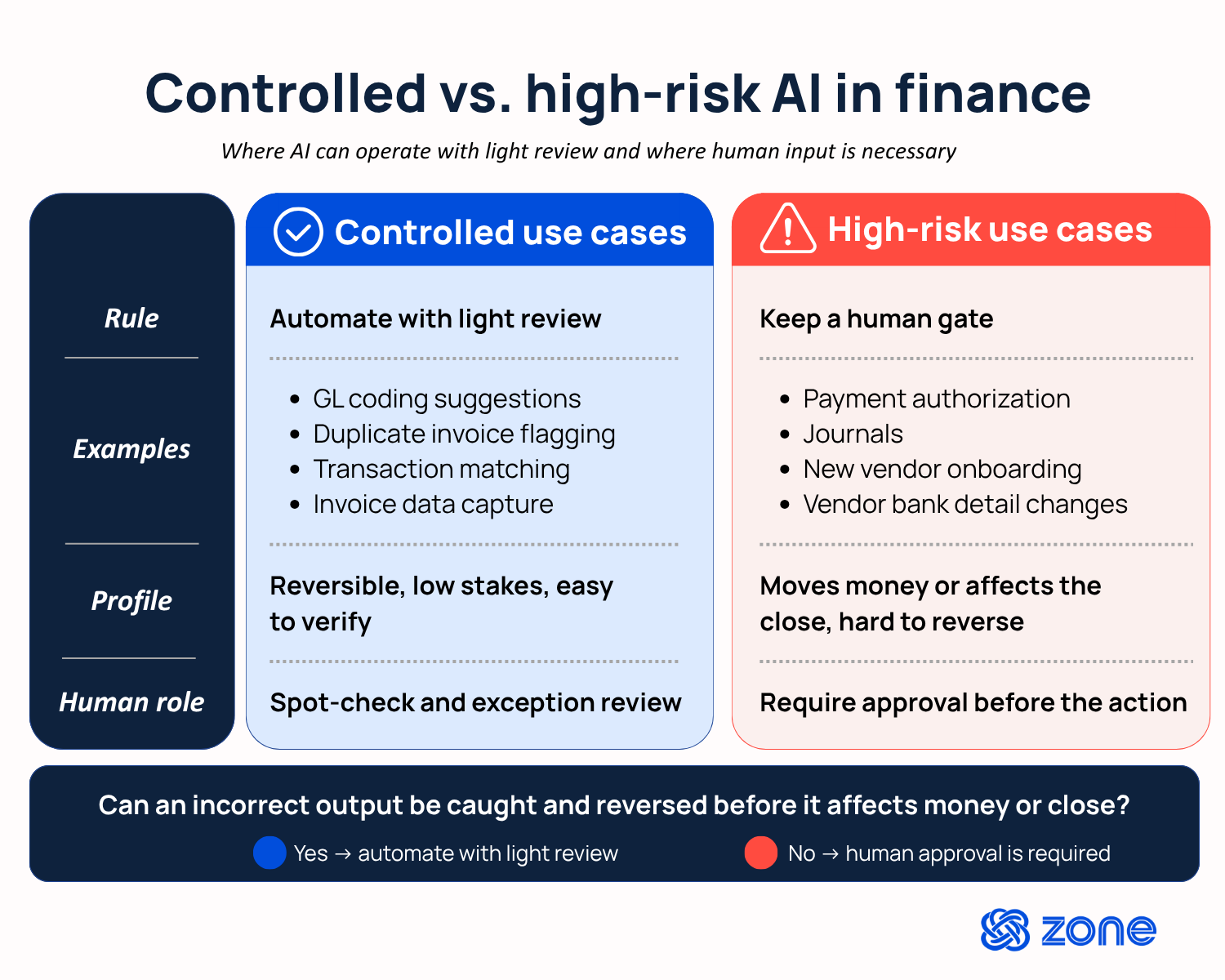
Five steps turn that discipline into an explainable workflow:
- Pick a workflow with clear review paths: Choose a process that’s already mapped, has clean data and a named owner, such as AP invoice coding or bank reconciliation matching. Explainability needs a known baseline to check against: a defined process gives the AI’s output a clear standard and a person accountable for it.
- Define what evidence must stay visible: Before automating, decide what the record has to show: source documents, the values the model suggested alongside the ones a person confirmed or changed, approval history and exception notes. That list becomes the acceptance test the workflow has to pass before it goes live.
- Anchor the work in NetSuite’s roles, permissions and audit trail: When AI-assisted coding or matching runs inside it, you can stand behind the result, with the evidence that backs it already in place.
- Use approval and exception steps where judgment still applies: Some cases need a human. Route those to a person and let the rest flow, so human attention lands where the model is least sure and the stakes are highest.
- Expand once the workflow is repeatable, reviewable and recoverable: Measure accuracy, exception volume and time per cycle against the acceptance test you defined earlier. Once those numbers hold, the workflow is safe to expand, and the next one can follow the same path.
As you expand to support multiple workflows, remember that a single AI agent can code an invoice or match a transaction on its own. But the value compounds when those tasks share ERP context, respect the same permissions and pass evidence from one task to the next. Finance teams getting the most from AI orchestrate it across connected, NetSuite-native workflows.
Bring AI into NetSuite-led workflows with auditability and control
If you want proof that keeps up across a whole finance operation, you need to keep the AI work – and the records it touches – in one place. Zone brings AI, automation and orchestration into one NetSuite-led finance platform across the end-to-end workflows that drive it. The evidence stays attached to the work, so AI can run the routine volume at speed – with human intervention when it’s needed and an audit trail that holds up at review and through close.
When AI is explainable, a finance team can open any coded transaction and find the source document, the fields AI suggested, the lines a human changed, the approval that cleared it and the name of the person who signed off. The same trail reaches all the way to the report, where ZoneReporting lets you trace any figure you have back to the detail behind it.
Book a demo to see how AI-assisted work stays traceable from source to outcome inside NetSuite.