


An email lands Monday morning with the subject line “An exciting update on our path forward.” In the all-hands meeting three hours later, the CEO announces that your company is an “AI-first organization and everyone needs to be on board with the vision. There are promises of automated workflows and more time for high-level strategy planning for all departments.
For most of the company, this announcement is energizing. For finance teams, it raises questions: How do we maintain compliance and data quality when using AI in accounting workflows? Will just accounts payable (AP) and accounts receivable (AR) be affected, or will the whole finance team need to use AI?
Whatever the case, finance teams need these skills to properly implement AI in their workflows while still maintaining control.
Key highlights:
- AI delivers its strongest results in finance when workflows are defined, data is reliable and someone owns the outcome.
- The skills finance teams need before AI scales are operational, not technical. Process clarity, judgment and control design come first.
- Zone & Co’s “AI Impact vs. Hype in Finance 2026” report found that where no one leads AI implementation, only 9% of finance teams report positive ROI.
- Professional skepticism is the competency that keeps AI honest inside finance workflows.
What “AI first” means for finance teams
AI-first mandates mean careful implementation and strategy for finance to maintain control, data fidelity and compliance in their workflows.
It doesn’t mean that finance sits back and watches AI do everything. Month-end close still has to happen. AP approvals still need an audit trail. Reconciliations still need to be right. What shifts is who does the work and what happens when something goes wrong inside an automated process.
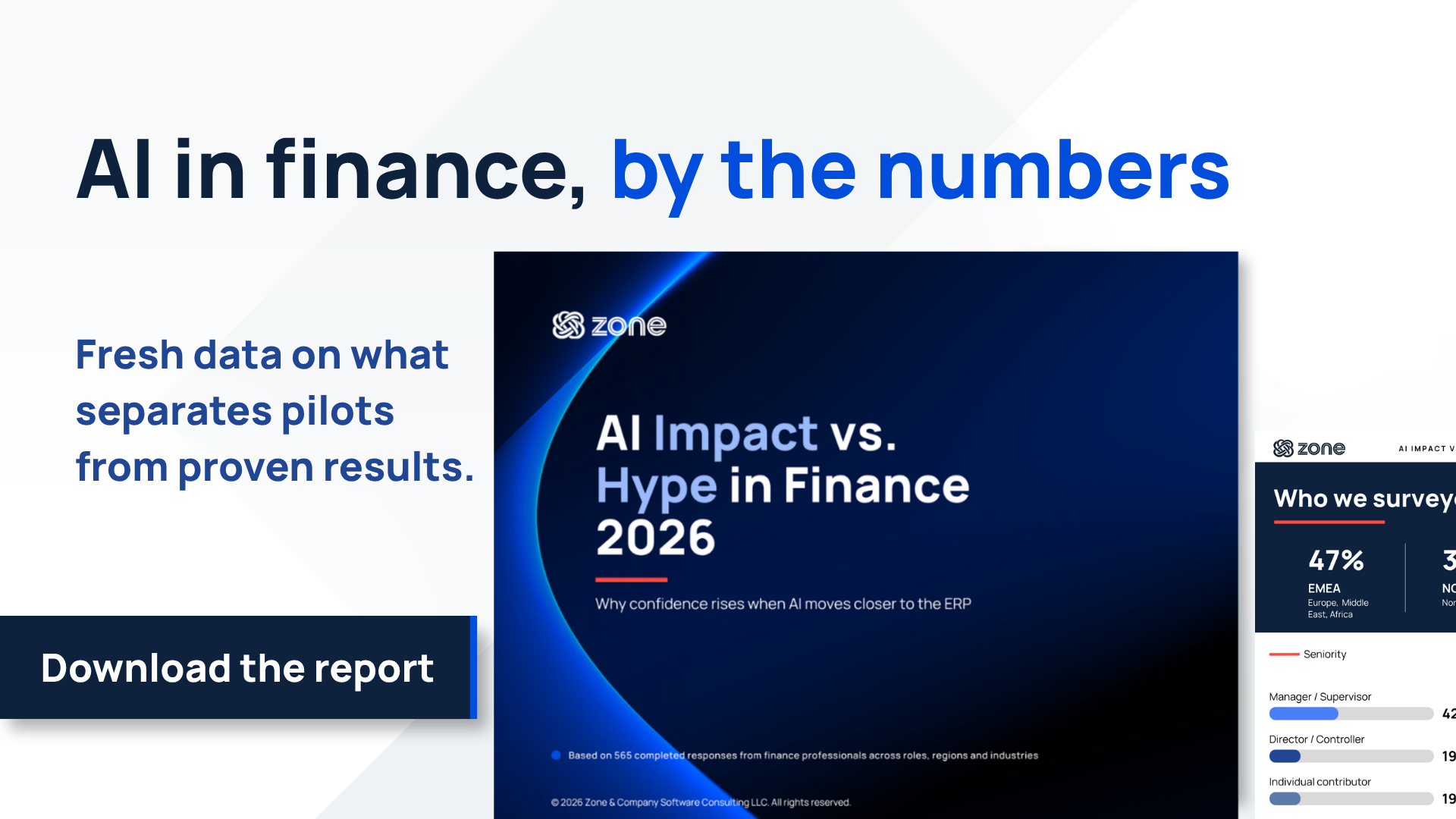
Zone’s “AI Impact vs. Hype in Finance 2026” report found that 38% of respondents said lack of skills was holding their finance teams back from deeper AI adoption. Other barriers were compliance risk (37%) and lack of integration (31%).
The skills that matter most right now are the ones that make AI adoption controlled, auditable and recoverable when numbers don’t line up – and most of them have nothing to do with the tools themselves.
7 skills finance teams need before implementing AI in workflows
Finance teams that succeed with AI tend to share the same foundation: they built operational discipline before they built automation. The seven skills below are what that foundation looks like in practice, with insights from Anthony Dixon, Zone & Co’s AI platform manager.
1. Process mapping
Process mapping is the act of documenting those answers with enough precision that they can be handed to an automated system.This skill is crucial because if you apply AI to an undefined process, that process won’t improve.
Before any AI tool touches a finance workflow, someone needs to know exactly what that workflow is. What are the inputs? Where does data come from? Who touches it between arrival and close? What happens when something is wrong?
Finance teams that map their AP workflows before automating them move through implementation in a fraction of the time of teams that tried to map in parallel. That map is also what makes exceptions visible. If you cannot describe the standard case in writing, you cannot build a reliable exception path for the cases that fall outside it.
- Map current-state workflows, step-by-step
- Document data inputs, owners and handoff points for each step
- Identify which steps are rule-based and which require ad-hoc judgment
Dig deeper: The rise of agentic finance orchestration
2. Data quality judgment
Data quality judgment is the ability to assess whether a dataset is clean enough to trust, before it becomes the foundation for an automated workflow.
AI is only as reliable as the data it processes. Finance teams that implement AI on top of inconsistent, incomplete or unreconciled data tend to discover the problem after automation is live, when outputs have errors that only surface at month-end.
“Automate the exploration,” Dixon advises. “When something doesn’t feel right in the output, you need to be able to chase the error down to its source quickly – not spend a week reconciling spreadsheets. The teams that get this right treat investigation as a built-in workflow, not a fire drill.”
Having this skill involves reading the source data, checking for gaps, identifying fields where inconsistency is common and knowing which conditions make a dataset safe to automate against. Zone’s AI in Finance report found that 38% of finance teams cite data quality as one of their main barriers to deeper AI adoption. The teams moving past that barrier are the ones that treat data quality as a pre-deployment requirement rather than a post-launch cleanup task.
- Audit source data before connecting it to an automated workflow
- Define acceptable data quality thresholds for each use case
- Build a remediation step for common data gaps before go-live
3. Control design
Control design is deciding where human review is mandatory, where AI can act autonomously and where the boundary between them lives. Without it, automation moves into spaces where accountability was never reassigned.
The stakes are high because control gaps in finance workflows aren’t always visible immediately. “Review by default, but build the flexibility in so it can be backed off over time. Start with humans in the loop, watch where the AI is consistently right, and earn the right to relax review as the evidence comes in,” Dixon says. Finance teams with strong control design skills build the human checkpoints into the workflow before the tool goes live, not after the first audit finding.
- Define approval thresholds and escalation paths before automating
- Assign explicit human review checkpoints for each AI-assisted step
- Document who is accountable for each control point in the workflow
4. Exception management
Exception management is the skill of designing what triggers an exception, where it routes, who owns resolution and how it gets logged. Every automated workflow produces exceptions, but it’s crucial to have a path for automated exceptions before implementing AI. “Have the agent highlight what actually went wrong, not just that something went wrong,” Dixon recommends.
Finance teams that skip this step tend to discover the gap at close. An exception hits at day eight of the close, sits in a queue with no clear owner and delays the whole cycle. Strong exception management means the unusual case has a defined home before the standard case is automated. It also means the exception log is a data source: a record of what went wrong and a signal for which workflow rules need refinement.
- Define exception triggers and routing rules for every automated workflow
- Assign a named owner for each exception type before go-live
- Review exception logs regularly to identify patterns worth addressing upstream
5. Systems thinking
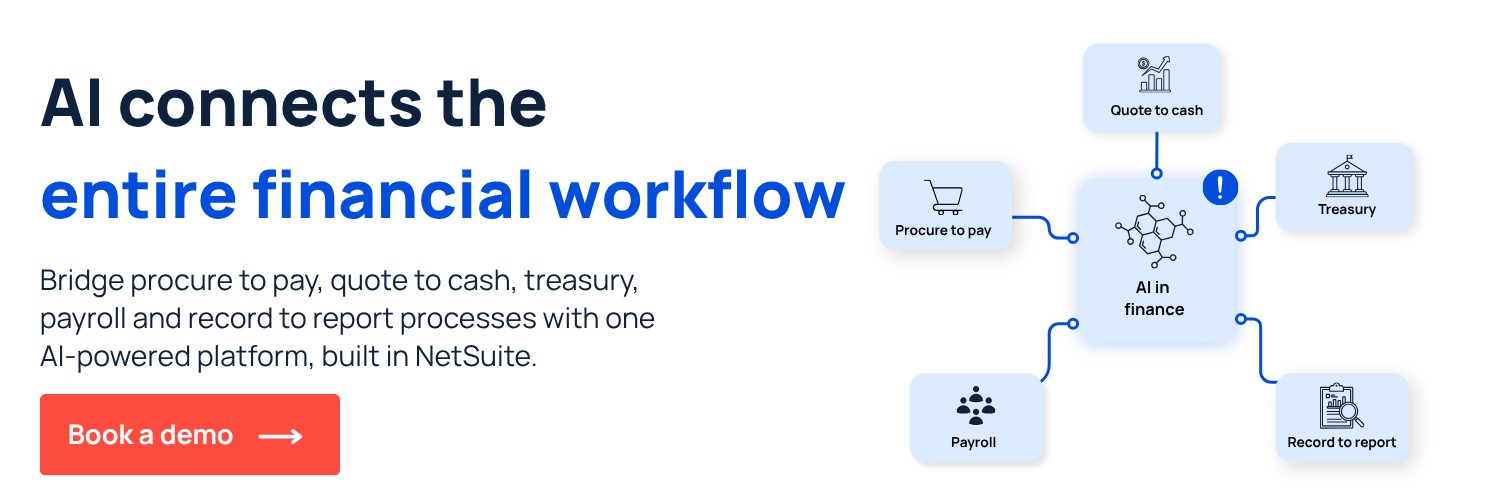
A change to one part of the finance process – procurement, AP, AR, treasury and reporting – creates effects upstream and downstream that may not surface for weeks. Systems thinking is the ability to trace workflow dependencies and anticipate where an automation decision in one area creates new exposure somewhere else.
This competency becomes more valuable as AI adoption expands across AP processing, approval routing, reconciliation matching and close reporting. It creates a more interconnected system where a failure in one spot can spread quickly. Finance professionals with strong systems thinking can read a workflow map and identify which processes have the most risk.
- Map the upstream and downstream connections for every workflow before automating
- Identify which workflow nodes carry the highest downstream risk
- Build a monitoring process that looks at cross-workflow effects, not just individual outputs
6. Workflow ownership
Workflow ownership is the skill of taking defined accountability for an AI-assisted process: its scope, its controls, its exceptions and its outputs.
Ownership means actively monitoring the workflow, not just holding a title. It means knowing what the tool is doing, reviewing what it is producing and escalating when something looks wrong. The Zone & Co report found that where CFOs or finance leadership owns AI implementation, 46% of teams report positive ROI. Where no one owns it, that figure drops to 9%. The teams converting that investment into positive ROI are the ones where someone is accountable for the outcome — not just the rollout.
- Assign a named owner for each automated workflow before go-live
- Define what active ownership looks like: review cadence, escalation criteria and scope boundaries
- Ensure ownership transfers explicitly when roles change
7. Professional skepticism
Professional skepticism is the trained habit of asking whether an output is correct before treating it as final – regardless of how clean it looks.
“This is the most important skill on the list. Models still have a jagged frontier of competence – brilliant on one task, brittle on the one next to it – and the only way to find the edges is to hunt for the inconsistencies,” Dixon says. “When you find one, don’t just fix the output. Dig in, improve the process, get more explicit with the AI about what you actually want. Skepticism is the loop that makes everything else compound.”
Finance teams that treat AI confidence as a substitute for review are the ones most exposed when the tool makes a systematic error.
- Establish review checkpoints with defined variance thresholds for every AI-assisted output
- Train reviewers to interrogate high-confidence outputs, not just low-confidence ones
- Build a regular audit process that tests AI outputs against verified data
AI in accounting best practices
Implementing AI in accounting workflows requires more than selecting the right tool. The practices below reflect what separates controlled, auditable adoption from the kind that creates correction work downstream.
- Start with one defined workflow: Pick a process that is already mapped, has clean data and has a named owner. Attempting multiple simultaneous automations before the first one is stable adds coordination cost and makes it harder to attribute problems to their source.
- Keep AI inside your finance system of record: AI that operates outside the ERP requires finance teams to reconcile its outputs back into the system where the audit trail lives. Zone & Co’s AI 2026 report found that 87% of broad AI adopters report high confidence in ERP-native AI, compared to 39% of teams still in pilot mode. The closer AI stays to where the data and controls already exist, the more defensible the output.
- Define what human review looks like at each checkpoint: Genuine control specifies who reviews, what they are checking for, what threshold triggers an escalation and how the review is logged.
- Treat the audit trail as a first-class output: Every AI-assisted action inside a finance workflow should produce a record of what the system did, what the reviewer confirmed and who took the final action. If that record is incomplete, the workflow has a control gap before the first transaction runs.
- Measure outcomes before expanding scope: Define what good looks like for the first workflow – accuracy rates, exception volume, time per cycle – and measure against that standard before adding the next automation. Teams that expand before measuring tend to distribute problems before they have identified them.
Bring AI into finance workflows without losing control
Finance teams need AI that works where financial control already lives: inside the ERP. That means source data, workflow logic, approvals, exceptions and audit trails stay connected – not scattered across another set of tools finance has to reconcile later.
Zone brings AI-powered automation into NetSuite workflows across billing, payments, AP, approvals, reconciliation, payroll and reporting – with the control finance teams need to trust the results. Every workflow is built around visibility, traceability and auditability, so teams can move faster without losing sight of what happened, who approved it or where the data came from.
Because genuine “AI-first” finance means fewer manual bottlenecks, cleaner workflows and stronger confidence in the numbers, not less control.
Explore how Zone helps finance teams use AI inside NetSuite – with the auditability and control your ERP was built to provide. Book a demo today.