

Growth and any major changes in a company impacts the way they spend. More teams buy software, services, contractors, equipment and subscriptions; more managers approve purchases, vendors enter the business and renewals happen in the background. Suddenly the controller is trying to explain the spend that was committed weeks or months before finance ever saw an invoice.
Getting visibility to and controlling spend before it happens is a common procure-to-pay problem. For many controllers, it’s even harder because there may not be a dedicated procurement team and the actual purchasing activity is happening in emails that are 46 threads deep, across five spreadsheets, three separate order forms and 1:1 department-level conversations.
Even a lightweight procurement process gives controllers a way to bring structure to purchasing without slowing the business down. Here are the controls procurement software can provide and how to enforce those controls regardless of growth.
Key highlights:
- Company changes (both growth and downsizing) exposes weak points in the procurement process, especially around intake, approvals, vendor selection, renewals and exception handling.
- Controllers need procurement controls that help them manage spend before it becomes an invoice, not just react during reconciliation.
- AI-enabled procurement workflows can guide employees to the right request path, surface existing vendors, compare order forms, analyze budget impact and summarize contract risk.
- The best procure-to-pay solutions help finance teams create guardrails, maintain visibility and keep procurement activity connected to NetSuite.
Why procurement gets harder for controllers to control as companies change
Procure-to-pay often starts informally. A department head needs a tool, someone emails finance, a manager approves over Slack, a contract gets signed and the invoice arrives later for AP to process.
That may work when the company is small. But as the business scales, the following control gaps can appear:
- Different processes for different teams: Procurement processes can vary wildly across teams. One department may use Slack or ad-hoc requests to approve vendors and purchases while another uses structured workflows and spending thresholds for approval and onboarding.
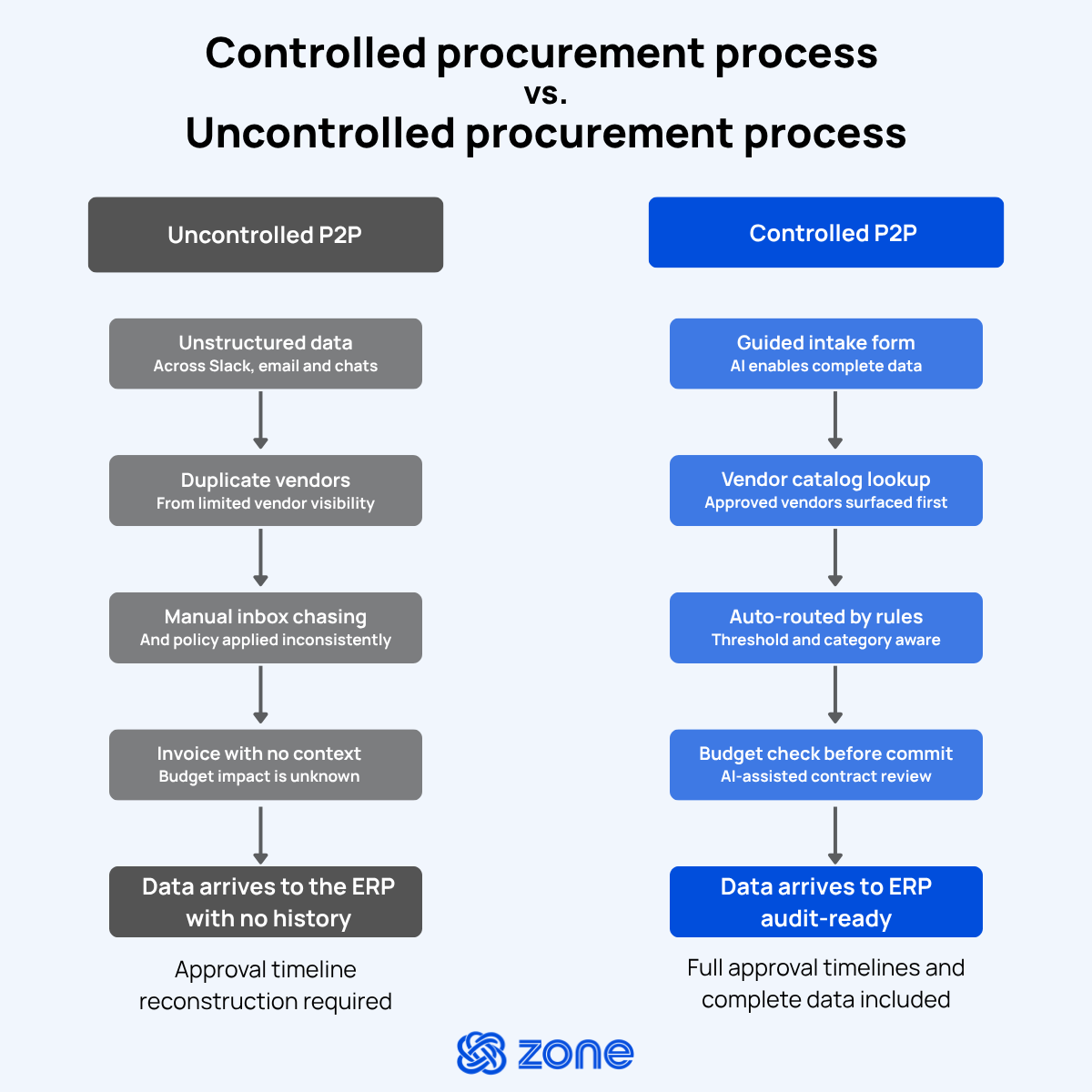
- Disconnected tools: When the entire procurement process is across Slack, Google Drive, spreadsheets and project management platforms before data enters NetSuite, controls are harder to maintain. Can you see who approved vendors, what spend has already been committed, when contracts renew and if the request is in budget?
- Upstream gaps: Accounts payable (AP) workflows slow down when procurement workflows have no control. Invoices show up without context or documentation and the tech stack is filled with redundant tools.
- Cash, close and reporting visibility: When procurement is uncontrolled, finance loses forward visibility. Controllers can see what has hit the general ledger, but not always upcoming commitments, renewals or approved-but-not-yet-invoiced spend. That affects cash forecasting, accruals, budget management and close confidence.
Procurement controls that help controllers manage spend before it happens
Controllers need technology that makes the right path easy, which means letting employees see existing vendors, submit requests, capture information upfront and route requests based on risk, amount, category and policy. A modern workflow should answer:
- Should we buy this?
- Who needs to review it?
- What data does finance need before this becomes a commitment?
Standardized approval rules that reduce policy drift
Policy drift happens when teams interpret purchasing rules differently. One department may ask finance before signing anything. Another may involve finance only when the invoice arrives. Another may approve purchases informally because the amount seems small.
Controllers can reduce policy drift by standardizing approval paths inside the procurement workflow. Rules should be based on amount, department, entity, category, vendor status, budget impact and risk profile. Instead of relying on employees to remember policy, the workflow applies it for them.
How AI improves this control: AI can help classify requests, identify the right category, suggest the appropriate approval path and surface requests that may need extra review because they are out of budget, involve a new vendor or include unusual terms.
Standardized intake that produces cleaner procurement data
AI-enabled intake can make capturing intent early easier. Instead of asking employees to choose from a long list of forms, the employee can describe what they need in plain language: “I need to renew with Okta,” or “I want to buy another Adobe seat.”
The system can guide the user to the right request category, prompt for the right fields and pre-populate information from submitted documents. Better intake creates cleaner data: finance gets a complete request, reviewers get context and AP is less likely to receive an invoice with missing information.
How AI improves this control: AI can suggest field responses, summarize submitted documents and guide the requester through missing information, while still requiring the user to review and submit the request. That keeps the process auditable while reducing manual work.
Vendor guardrails that prevent duplicate or unnecessary spend
One powerful control happens before a request is created: showing employees whether the company already has a vendor, contract or seat they can use.
A vendor catalog gives employees a controlled view of approved vendors and relevant non-financial information. This helps prevent duplicate tools, unnecessary order forms and avoidable new vendor management before a purchase request, purchase order or invoice exists.
How AI improves this control: AI can let employees ask questions like “Do we already have a CRM?” or “Is there an approved vendor for this?” and return relevant vendor, contract or usage context before a new request is submitted.
Budget, risk and contract review before approval
A strong procurement workflow can route requests based on category, entity, department, vendor, contract value, budget impact, renewal timing and risk. It can escalate stalled approvals, show approvers the right documents and require added review when a request is out of budget, involves a new vendor or changes terms.
Once a request is submitted, reviewers need context to understand why the request exists, what changed, what risk it creates and who approved it. That context helps controllers preserve the decision trail behind each purchase.
How AI improves this control: AI can compare a new order form against the prior version, highlight pricing changes, identify new SKUs, summarize DPAs or SOC 2 reports, analyze budget impact and surface historical spend from NetSuite so reviewers can make faster, better-informed decisions.
Approval visibility that reduces inbox chasing
Procurement controls fail when finance has to chase approvals across email, Slack, spreadsheets and side conversations. Employees may not know where to submit requests. Approvers may not know what they are approving. Controllers may not know whether spend is requested, approved, committed, renewed or already invoiced.
A controlled workflow gives each stakeholder visibility into status, ownership and next steps. It also preserves the approval history so finance can support audits, review exceptions and understand how purchasing decisions were made.
How AI improves this control: AI can summarize request history, flag stalled approvals, explain what changed since the prior request and give controllers faster visibility into open items without manually reconstructing the decision trail.
What controllers should look for in AI-powered procurement software
Controllers should look beyond basic request routing. The solution should help finance control spend earlier, make intake easier and create usable data for downstream finance work.
Here’s what to look for when comparing top procurement and procure-to-pay solutions when building out a controlled pre-spend workflow.
Procurement best practices for controllers building AI-ready controls
Procurement best practices should focus on visibility, consistency and proactive control. For controllers, the goal is not to add AI on top of a messy process. It is to create structured workflows, clean data and clear control points that AI can support reliably.
AI-ready procurement controls work best when finance can trust the underlying workflow. That means requests are categorized consistently, approvals follow policy, vendor and budget context is available and procurement activity stays connected to the enterprise resource planning (ERP) platform.
Standardize procurement approval paths
Approval paths should be standardized before every department invents its own version of procurement. Define who approves what, when finance gets involved and which categories require additional review.
The workflow should make those rules automatic. Employees should not have to remember the policy, and controllers should not have to chase every exception manually.
Start with the highest-risk routing rules:
- Spend amount and threshold
- Department and entity
- Vendor status
- Category and risk level
Connect procurement workflows to downstream ERP automation
When request details, vendor information, approval history, budget context, documents and renewal data are captured consistently, that information can support the finance workflows that happen downstream. For controllers, this helps create a cleaner handoff from procurement into purchase orders, invoices, payments, reporting and ERP-connected automation.
Make procurement data finance-ready:
- Clean vendor details
- Structured approval history
- Budget and commitment context
- PO and invoice readiness
Build AI-supported controls around procurement exceptions
Exceptions are where procurement risk concentrates. Out-of-budget requests, new vendors, changed payment terms, urgent renewals, unusual contract language and missing documents all need clear review paths.
A good process makes exceptions visible, documented and approved by the right people before the business is committed.
Define which exceptions need escalation, for example:
- New vendor requests
- Out-of-budget spend
- Missing documentation
- Changed contract terms
Use AI to make renewals visible before they become surprises
Renewals are one of the easiest places for spend to escape control. A contract may auto-renew before finance has reviewed usage, budget, vendor performance or alternatives.
AI-generated contract summaries and structured SKU data can support renewal calendars, reporting and reminders. That helps finance review renewals before the company is committed again.
Capture these details early:
- Renewal date
- Contract owner
- SKU and seat data
- Budget impact
Review procurement controls as the business changes
Procurement controls should evolve as the company grows, restructures or adds new entities, departments, vendors and systems. A workflow that worked last year may not support the current level of spend complexity.
Controllers should review procurement controls regularly to make sure policies still match how the business buys. This is especially important as AI-assisted workflows become more dependent on clean, consistent data.
Review the control environment to ensure:
- Intake is working
- Approval rules still match policy
- Budget checks happen early enough
- Renewal data is complete
- Procurement activity is visible in finance reporting
Get proactive procurement control with ZoneProcure by Zone & Co
Controllers need a better way to see and control spend before it happens, while keeping the process simple enough for employees to use.
ZoneProcure helps finance teams bring procurement intake, approvals, vendor context, AI-assisted review and renewal visibility into a more controlled workflow:
- Employees can start requests in natural language.
- Teams can see existing vendors before creating new spend.
- Reviewers can use AI to compare order forms, analyze budget impact, summarize contracts and evaluate vendor risk documents.
- Finance can keep procurement activity connected to NetSuite context and downstream workflows.
And with the wider Zone platform, we help controllers build a connected finance operating model.
Procurement control should not start at invoice arrival. It should start when someone first decides they want to buy something. With ZoneProcure, controllers can move from reactive cleanup to proactive spend control and give the business a clearer path to buy responsibly.