

Starting September 1, 2026, Vat-taxable businesses established in France must be able to receive e‑invoices, regardless of size. This creates a fundamental shift in how NetSuite users handle invoice processing, tax reporting and cross-border transactions. Non-established companies may have separate e-reporting obligations, depending on their French VAT-liable transactions.
The challenge goes beyond format conversion. France’s reform introduces approved platforms that sit between your NetSuite instance and your trading partners, e-reporting requirements beyond domestic B2B transactions and phased timelines that compress implementation windows.
Key highlights:
- France’s e-invoicing mandate requires all businesses to receive structured invoices, with large and mid-sized companies also required to issue e-invoices and comply with e-reporting through government-approved providers, also called “plateforme agréée” (PA).
- The reform has two components: e-invoicing for domestic B2B transactions and e-reporting for cross-border B2B, B2C sales and payment data.
- NetSuite e-invoicing integration must connect to approved platforms, support required formats (Factur-X, UBL, CII) and automate data transmission to French tax authorities.
- ZoneCapture e-invoicing helps NetSuite finance teams prepare for France’s e-invoicing mandate by keeping invoice workflows inside NetSuite and connecting to approved platform infrastructure for supported mandate flows.
What is e-invoicing and why is it important?
E-invoicing is the exchange of structured invoice data between systems using defined digital formats. Unlike PDF invoices sent via email, NetSuite electronic invoicing delivers machine-readable data that flows automatically through secure networks and government platforms.
For businesses adapting to France’s regulatory landscape, implementing NetSuite e-invoicing eliminates manual data entry, reduces errors and creates audit trails that tax authorities can validate. When invoice data is captured electronically, your NetSuite invoice automation matches transactions to purchase orders, routes approvals automatically and posts to the general ledger without manual intervention.
France’s mandate makes e-invoicing compulsory for domestic B2B transactions. This means every NetSuite user operating in France needs an e-invoicing solution that establishes a path to compliance and prepares them for broader European e-invoicing regulations with VAT in the Digital Age (ViDA) initiatives.
What’s changing in France’s e-invoicing regulation?
France is implementing mandatory e-invoicing and e-reporting to its Direction générale des Finances publiques (DGFiP) tax authority by creating continuous transaction controls.
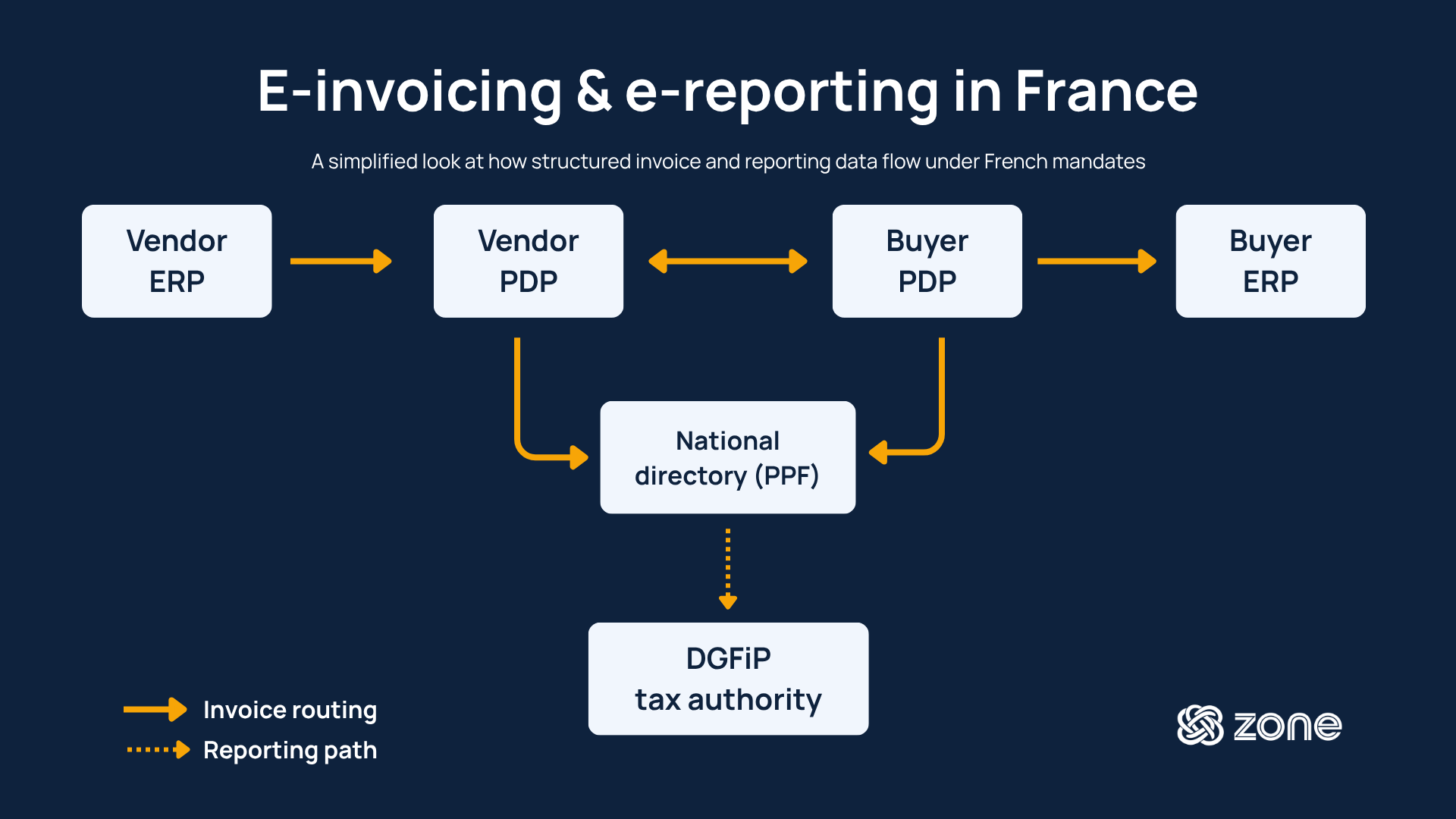
The reform has two core components: e-invoicing and e-reporting
E-invoicing applies to domestic B2B transactions between companies established in France and liable for VAT. These businesses must issue and receive invoices in structured formats (Factur-X, UBL or CII) through a government-approved platform.
E-reporting applies to transactions not covered by mandatory e-invoicing, including cross-border B2B sales, B2C transactions and payment data. Companies must transmit this information to the Portail Public de Facturation (PPF) through their approved platform.
The rollout is phased by company size
France is implementing e-invoicing in two waves, giving smaller businesses additional time to prepare while ensuring all companies can receive e-invoices from day one.
The September 2026 deadline creates an immediate universal requirement: every business operating in France must be capable of receiving structured e-invoices. This means even the smallest companies need functioning PA connections and technical infrastructure in place by that date.
September 1, 2026: All B2B businesses must receive e-invoices. Large enterprise and mid-sized companies must also issue e-invoices and comply with e-reporting.
September 1, 2027: SMEs and micro-enterprise businesses must issue e-invoices and comply with e-reporting.
Approved platforms now sit in the middle of the process
Domestic B2B e-invoices must be exchanges\d through a PA – formally referred to as Plateforme de Dématérialisation Partenaire (PDPs). These are government-certified service providers that route invoices, validate data, transmit e-reporting to tax authorities and manage invoice lifecycle statuses.
France’s national directory identifies which PA manages each business’s invoicing data using SIREN numbers.
For B2C and certain cross-border transactions, relevant transaction and payment data must be transmitted through the approved-platform model rather than exchanged as domestic B2B e-invoices.
Invoice content and technical requirements are changing
France requires invoices in Factur-X (hybrid PDF with embedded XML), UBL 2.1 or CII format. Invoices must include mandatory and conditional data fields defined by DGFiP, with additional requirements phasing in over time.
Which businesses are affected by the French e-invoicing mandates?
France’s e-invoicing mandate applies broadly to any business that conducts B2B transactions in France and is registered for French VAT.
The requirement is based on establishment in France, not just VAT registration, which creates different obligations for domestic companies versus foreign entities:
- Domestic B2B transactions trigger the e-invoicing requirement when both supplier and customer are established in France and liable for VAT. These invoices must be issued through an approved platform in structured format (Factur-X, UBL 2.1 or UN/CEFACT CII).
- Cross-border transactions don’t require e-invoicing (yet), but they will require e-reporting.
- B2C transactions are exempt from e-invoicing requirements, but are subject to e-reporting. Sales to consumers don’t go through approved platforms, but transaction data must be reported to tax authorities.
Why French businesses need to implement e-invoicing now
September 2026 feels distant until you map actual implementation work. Finance teams starting in Q2 2026 will discover they’re already late since the total timeline could take an estimated 32 to 44 weeks from kickoff to production.
The deadline is fixed, but readiness takes longer than teams expect
- Provider selection could take four to six weeks to evaluate approved platforms, compare pricing and verify NetSuite invoice processing compatibility
- Process mapping may take six to eight weeks to document workflows, identify exceptions and define approval chains
- Data cleanup can take eight to 12 weeks to validate customer SIREN numbers, standardize formats and fix tax classification
- ERP integration may require eight to 10 weeks for NetSuite-to-PA connectivity, data mappings and automated e-reporting workflows
- Testing and onboarding may take six to eight weeks minimum for end-to-end validation with trading partners and team training
The reform touches more stakeholders than a normal finance project
E-invoicing implementation requires coordination across functions that don’t typically work together on finance initiatives:
- Finance owns compliance risk and depends on other teams for accurate transaction data and timely processing
- Tax validates invoice classifications, VAT treatment and e-reporting logic while monitoring DGFiP guidance updates
- IT manages technical integration between NetSuite invoices and the PA, handles data security and troubleshoots production issues
- Procurement ensures supplier readiness by communicating requirements and tracking compliance status
- Order-to-cash teams maintain customer data accuracy (SIREN numbers, PDP routing details) and ensure invoices generate with required fields
- External service providers (PA vendors, NetSuite partners and tax consultants) each bring part of the solution, but don’t own the complete picture
The cost of delaying compliance to France’s e-invoicing mandates
Late starts force finance teams to accept less-than-ideal outcomes because time has run out to build proper solutions. These may include:
- Settling for whichever PDP can onboard fastest rather than best fit
- Building workarounds for edge cases discovered too late to fix properly
- Launching with incomplete data that creates manual exceptions
- Skipping adequate training
- Accumulating technical debt from rushed configurations
How to prepare for France’s e-invoicing shift
Successful implementation requires understanding your exposure, validating your architecture and building flexibility for future regulatory changes.
Map your exposure
Identify which entities are established in France with VAT registration, document transaction volumes by type (domestic B2B, cross-border, B2C), flag exception scenarios that need specific handling and assess supplier and customer readiness timelines.
Identify affected entities, flows, and transaction types.
Assess your current invoicing architecture
E-invoicing impacts both accounts payable (AP) and accounts receivable (AR). Your NetSuite invoice automation must generate invoices with required fields and transmit through the PA, while incoming e-invoices need to match automatically to purchase orders and post without manual entry. Validate customer and vendor master data (SIREN numbers, addresses, tax classifications) and confirm your NetSuite generates structured formats, not just PDFs.
When evaluating top invoice processing systems with automated compliance checks for e-invoicing, verify that your chosen solution validates customer master data, confirms tax classifications and ensures line-item details meet French requirements before invoice generation.
Build a platform strategy early
Evaluate PAs based on NetSuite integration depth, transaction pricing, e-reporting automation and multi-country capabilities. Consider NetSuite-native solutions like ZoneCapture that eliminate middleware integration. Plan for both AR (sending) and AP (receiving) workflows, and clarify data ownership and archiving requirements.
Plan for regulatory evolution, not just day-one compliance
Monitor ongoing DGFiP updates, design for format flexibility as requirements evolve, build reporting agility to adapt data elements and prepare for cross-border harmonization under the EU’s ViDA initiative by 2030.
Common challenges in NetSuite e-invoicing compliance
Finance teams implementing France’s mandate will likely experience technical, operational and data quality obstacles beyond basic compliance. These are the common challenges you may run into and how to overcome them.
Navigating complex technical standards
Converting from PDF invoices to structured XML formats isn’t a simple format change. NetSuite invoice data must map to specific XML schemas with precise field names, data types and validation rules that differ across Factur-X, UBL and CII formats. When specifications evolve or approved platforms update their requirements, finance teams face integration breaks, invoice rejections and compliance gaps.
Without proper lifecycle status synchronization, teams may lose visibility into whether invoices were accepted, rejected or paid. They’re also forced to log into separate PA portals to check status, creating manual work that defeats the purpose of automation.
Here’s how to address this:
- Map NetSuite invoice fields to required XML schemas before go-live and validate output against PA test environments
- Monitor DGFiP updates and approved platform release notes for specification changes
- Implement automated status synchronization so invoice lifecycle updates (sent, accepted, rejected, paid) flow back into NetSuite
- Build validation rules in NetSuite that catch format errors before transmission to reduce rejection rates
- Work with NetSuite partners who maintain current technical specifications and update integrations as requirements evolve
Managing multi-entity and international requirements
Companies with multiple French subsidiaries may run into separate PDP connections, SIREN registrations and directory enrollments for each entity. Cross-border transactions add another layer, as they don’t require e-invoicing but do require e-reporting with different data elements and transmission rules.
When finance teams manage both domestic and international transactions, they risk misclassifying invoices, missing e-reporting deadlines or sending transactions through the wrong workflow.
How to address this:
- Map each French entity to its SIREN number, PA connection and directory registration status
- Configure NetSuite invoicing to automatically route domestic B2B invoices through e-invoicing workflows and cross-border transactions through e-reporting
- Implement transaction classification logic that identifies which invoices require e-invoicing versus e-reporting based on customer location and VAT status
- Coordinate e-invoicing implementation timelines with broader European mandates like those in Belgium, Germany, Spain and Nordic countries to avoid rebuilding processes
- Centralize multi-entity configuration in NetSuite so changes to PA connections or formats don’t require separate updates per subsidiary
Avoiding data entry and workflow errors
E-invoicing automation only works when master data is clean and complete. Missing SIREN numbers, incorrect addresses, inconsistent tax codes or malformed data fields cause invoice rejections at the PA level. When invoices fail transmission, finance teams scramble to identify the root cause, fix the data and resubmit before payment deadlines.
Inconsistent invoice templates across subsidiaries, manual data capture from emails or spreadsheets, and lack of validation before transmission create error rates that undermine compliance and delay payments.
How to address this:
- Standardize invoice templates and required data fields across all French entities
- Automate data capture from sales orders, contracts and recurring billing to eliminate manual entry
- Train AP and AR teams on PA status codes, rejection reasons and exception handling workflows
- Enforce data formatting rules for SIREN numbers, addresses and tax classifications in NetSuite customer and vendor records
- Build approval workflows that flag incomplete invoices before they reach the PA
Prepare for French e-invoicing inside NetSuite with ZoneCapture
France’s mandate requires more than converting PDFs into XML. Businesses need a way to exchange structured invoices through approved platform infrastructure, support e-reporting obligations where applicable, and keep invoice processing visible inside their ERP.
ZoneCapture e-invoicing by Zone & Co helps NetSuite finance teams prepare by keeping invoice workflows inside NetSuite while connecting to trusted e-invoicing infrastructure for supported mandate flows. That means teams can work toward compliance without creating a separate AP process, separate approval queue, or manual handoff between systems.
For France, Zone is focused on the core mandate flows — sending, receiving, e-reporting and related invoice lifecycle requirements — while helping customers assess readiness, data quality and process impacts ahead of the 2026 rollout.
Book a demo today to understand what France’s mandate means for your NetSuite environment.